
September is Alzheimer's and Dementia Awareness Month, and one of the most consistent things families tell us at BrightStar Care of Baraboo is this: nobody prepared them for how hard communication would become.
The memory loss they expected. The personality changes they were warned about. But the specific, day-to-day experience of trying to have a conversation with someone whose brain can no longer process language, follow logic, or hold a thought the way it used to, and finding that everything they instinctively try makes things worse rather than better, that is something families often figure out alone, through trial and painful error.
This post is written to shorten that learning curve. It covers what actually works when communicating with someone who has dementia, what commonly backfires, and why the brain changes involved explain both.
In-home Alzheimer's and Dementia Care Services 608-355-5015
Dementia is not simply a memory condition. It is a progressive disease that affects multiple aspects of brain function, and several of those affect communication directly.
Language processing deteriorates over time. The person may lose words, substitute incorrect words without realizing it, struggle to follow the thread of a conversation, or lose the ability to understand complex sentences. In later stages, verbal communication may become very limited.
The ability to hold information in working memory, the mental workspace where we track what was just said and what we are responding to, declines early and significantly. This is why repeating information does not help: the problem is not that they did not hear you or did not pay attention. It is that the cognitive machinery for holding and processing the information is damaged.
Emotional processing is often relatively preserved even when language and memory are not. This is perhaps the most important thing families can understand about dementia communication. The person may not remember what was said, may not be able to follow the content of a conversation, but they will feel and remember the emotional tone of the interaction. A person with dementia who cannot recall a conversation from ten minutes ago can still feel comforted, safe, and respected, or anxious, shamed, and distressed, based entirely on how that conversation felt.
This is the foundation everything else builds on: in dementia care, the feeling of the interaction matters more than the content.
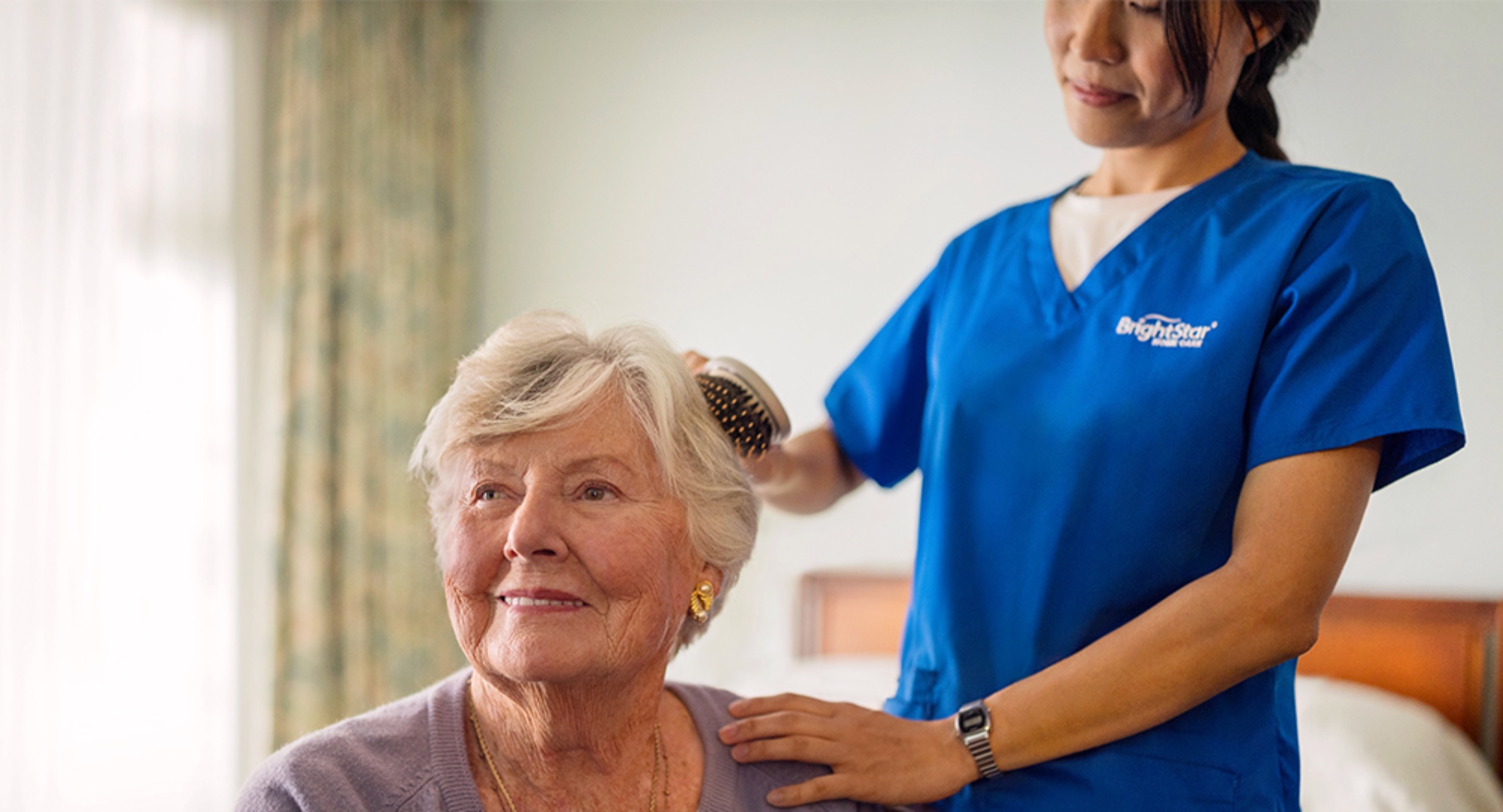
In-home Alzheimer's and Dementia Care Services 608-355-5015
In later stages of dementia, verbal communication may become very limited or largely absent. Families sometimes experience this as a profound loss of connection. But connection does not require language.
Presence matters. Sitting together, holding hands, making eye contact, playing familiar music, looking at old photographs together. These interactions sustain relationship in the absence of conversation. The person may not be able to tell you that they feel loved, but they can feel it. That feeling is real, and it matters to their wellbeing in ways that are measurable in their mood, their calm, and their sense of safety.
This is one of the things that consistent, trained caregivers do well: they learn the person's nonverbal language, the expressions and behaviors that communicate comfort, distress, or pleasure, and they respond to those signals with skill and warmth.
At BrightStar Care of Baraboo, our caregivers are trained in dementia communication and care approaches that are grounded in this understanding of how dementia affects the brain and what actually helps.
Our caregivers provide companionship, personal care, and daily support that is built around consistency, patience, and meeting the person where they are. Our skilled nursing team provides RN oversight, care plan coordination, and clinical monitoring that keeps the whole picture managed, including addressing the behavioral and emotional dimensions of dementia that affect communication and quality of life.
For families in Baraboo, Wisconsin Dells, Reedsburg, Portage, and surrounding Sauk and Columbia County communities, we are here to help, both with the care your loved one needs and with the guidance and support that families navigating dementia need for themselves.
In-home Alzheimer's and Dementia Care Services 608-355-5015
BrightStar Care of Baraboo provides skilled nursing and non-medical home care services for seniors and adults throughout Baraboo, Wisconsin Dells, Reedsburg, Portage, Sauk City, Prairie du Sac, and surrounding Sauk and Columbia County communities. To speak with a care coordinator about dementia care support for your loved one this September, contact our office today.
Contact Us Today:
The memory loss they expected. The personality changes they were warned about. But the specific, day-to-day experience of trying to have a conversation with someone whose brain can no longer process language, follow logic, or hold a thought the way it used to, and finding that everything they instinctively try makes things worse rather than better, that is something families often figure out alone, through trial and painful error.
This post is written to shorten that learning curve. It covers what actually works when communicating with someone who has dementia, what commonly backfires, and why the brain changes involved explain both.
In-home Alzheimer's and Dementia Care Services 608-355-5015

Why Communication Changes in Dementia
Dementia is not simply a memory condition. It is a progressive disease that affects multiple aspects of brain function, and several of those affect communication directly.Language processing deteriorates over time. The person may lose words, substitute incorrect words without realizing it, struggle to follow the thread of a conversation, or lose the ability to understand complex sentences. In later stages, verbal communication may become very limited.
The ability to hold information in working memory, the mental workspace where we track what was just said and what we are responding to, declines early and significantly. This is why repeating information does not help: the problem is not that they did not hear you or did not pay attention. It is that the cognitive machinery for holding and processing the information is damaged.
Emotional processing is often relatively preserved even when language and memory are not. This is perhaps the most important thing families can understand about dementia communication. The person may not remember what was said, may not be able to follow the content of a conversation, but they will feel and remember the emotional tone of the interaction. A person with dementia who cannot recall a conversation from ten minutes ago can still feel comforted, safe, and respected, or anxious, shamed, and distressed, based entirely on how that conversation felt.
This is the foundation everything else builds on: in dementia care, the feeling of the interaction matters more than the content.
What Works
- Use short, simple sentences. Long, complex sentences with multiple clauses are genuinely difficult for a person with dementia to process. Keep sentences to one idea at a time. Pause between sentences to allow processing time. Speak at a slightly slower pace than normal, without being condescending.
- Ask one question at a time, and make it simple. Open-ended questions like "What would you like for lunch?" require retrieval, comparison, and decision-making that may be beyond the person's current capacity. A yes-or-no question or a simple choice between two concrete options, "Would you like soup or a sandwich?" works better. One question, one answer, then move on.
- Approach from the front, calmly, at eye level. Approaching from behind, appearing suddenly, or looming over someone with dementia can trigger fear and defensive reactions. Come into their field of vision from the front, make eye contact, and get to their eye level if possible. These physical elements of approach communicate safety before a word is spoken.
- Use their name. Using the person's name at the start of an interaction orients them to the conversation and signals that you are speaking to them specifically.
- Match your tone to the feeling you want to create. Calm, warm, and unhurried. A gentle, steady voice communicates safety even when the words are not being fully processed. Conversely, tension, frustration, or urgency in your voice will register emotionally even when the verbal content does not.
- Use nonverbal communication actively. Facial expressions, touch, and gesture become more important as verbal communication becomes less reliable. A warm smile, a gentle hand on the arm, a gesture toward what you are referring to, these carry meaning when words are not landing.
- Enter their reality rather than correcting it. If a person with dementia believes they are somewhere else, or that a person who has passed is still living, or that they need to go somewhere they do not actually need to go, arguing the facts with them does not bring them into your reality. It causes distress, confusion, and conflict. This does not mean lying to them. It means engaging with the feeling and the need behind what they are expressing rather than the literal content of it. "You're missing your mother. Tell me about her." is usually more effective and more humane than "Your mother died forty years ago."
- Redirect rather than confront. When a person with dementia is fixated on something distressing or is moving toward a behavior that needs to be redirected, distraction and gentle redirection to a different activity or topic is almost always more effective than direct confrontation or logical explanation.
- Give time. Processing and responding takes longer for a person with dementia. Filling silences, jumping in to finish their sentences, or repeating the question before they have had a chance to respond creates pressure that makes communication harder. Wait. Give them the time they need.
- Focus on what they can still do. Even in advanced dementia, people often retain the capacity to enjoy music, respond to humor, engage with familiar objects, recognize faces they love, and feel the pleasure of physical affection and warmth. Communication is not only verbal. Meeting them where their capacities are, rather than only where they are not, sustains connection through the stages of the disease.
In-home Alzheimer's and Dementia Care Services 608-355-5015
What Does Not Work
- Correcting and reality-orienting. This is the most common and most damaging communication mistake families make, and it is completely understandable because it is the instinctive response. When someone says something that is not true, the impulse is to correct them. In dementia, correction does not work. The person cannot update their understanding through correction because the brain systems that would allow them to do so are damaged. What correction does do is communicate to the person that they are wrong, which generates shame, distress, and defensive reactions. Abandon the goal of making them accurate. Focus on making them feel safe and heard.
- Arguing or reasoning through resistance. When a person with dementia refuses to do something, bath, get dressed, take medications, the instinct is often to explain why it is necessary, to reason through their resistance, or to argue them into compliance. This rarely works and frequently escalates the situation. A different approach, giving it time and coming back, changing the caregiver who is asking, changing the environment, finding a gentle distraction, will almost always be more effective than persistence through reasoning.
- Asking if they remember. "Do you remember when we did that?" puts the person's deficit on display. They know, on some level, that they should remember, and cannot. This generates shame and distress without any productive purpose. Share the memory yourself instead, without making it a test.
- Talking about them as if they are not present. Even when cognitive impairment is severe, people with dementia often register being discussed in the third person as if they cannot hear or understand. The emotional experience of being talked around is humiliating. Always include the person in conversation, even if their participation is limited.
- Raising your voice. Unless there is a genuine hearing impairment, raising your voice to someone with dementia does not help comprehension. It communicates anger or alarm. Speak more slowly and more clearly rather than louder.
- Rushing. Rushing is one of the most consistent sources of distress in dementia care interactions. The person cannot speed up their processing to meet your timeline. When interactions are rushed, they become anxious and resistant. Build in more time than you think you need for any interaction that requires the person's participation.
- Multiple instructions at once. "Go to the bathroom, wash your hands, and then come sit down for lunch" is three instructions that require sequential processing and working memory. One instruction at a time, then wait for completion, then the next.
When Communication Becomes Nonverbal
In later stages of dementia, verbal communication may become very limited or largely absent. Families sometimes experience this as a profound loss of connection. But connection does not require language.Presence matters. Sitting together, holding hands, making eye contact, playing familiar music, looking at old photographs together. These interactions sustain relationship in the absence of conversation. The person may not be able to tell you that they feel loved, but they can feel it. That feeling is real, and it matters to their wellbeing in ways that are measurable in their mood, their calm, and their sense of safety.
This is one of the things that consistent, trained caregivers do well: they learn the person's nonverbal language, the expressions and behaviors that communicate comfort, distress, or pleasure, and they respond to those signals with skill and warmth.
How BrightStar Care of Baraboo Helps
At BrightStar Care of Baraboo, our caregivers are trained in dementia communication and care approaches that are grounded in this understanding of how dementia affects the brain and what actually helps.Our caregivers provide companionship, personal care, and daily support that is built around consistency, patience, and meeting the person where they are. Our skilled nursing team provides RN oversight, care plan coordination, and clinical monitoring that keeps the whole picture managed, including addressing the behavioral and emotional dimensions of dementia that affect communication and quality of life.
For families in Baraboo, Wisconsin Dells, Reedsburg, Portage, and surrounding Sauk and Columbia County communities, we are here to help, both with the care your loved one needs and with the guidance and support that families navigating dementia need for themselves.
In-home Alzheimer's and Dementia Care Services 608-355-5015
Frequently Asked Questions
Q: My parent keeps asking the same question over and over. How do I respond without losing patience?
Repetitive questioning is one of the most exhausting features of dementia caregiving, and it is driven by the same mechanism that makes correction futile: the brain systems that would register that the question has already been asked and answered are damaged. The question feels new each time it is asked. Answering it patiently, even the tenth time, is the most effective approach. It may help to write the answer on a card the person can refer to, if they still have the reading ability to use it. It also helps to address the feeling behind the question rather than only the content. "Are we going home?" often expresses a feeling of displacement or anxiety rather than a genuine desire for information. "You're safe here, and I'm with you" may settle the underlying feeling more effectively than an accurate factual answer.Q: My parent becomes aggressive or upset during personal care. What is going wrong and how do we fix it?
Resistance to personal care is one of the most common caregiving challenges in dementia, and it is almost always rooted in one or more of the following: the person does not understand what is happening and feels frightened or violated; the interaction is too rushed and the person feels pressured; there is pain or physical discomfort involved that they cannot articulate; or the caregiver is someone they do not feel safe with. Slowing down, explaining each step before doing it, using warm and reassuring language throughout, ensuring physical comfort, and building a consistent trusting relationship with the person providing care, these are the most effective interventions. If a particular caregiver consistently triggers resistance, a different caregiver may produce a completely different result.Q: Is there a point when communication becomes so limited that it no longer matters how we interact?
No. Research on dementia consistently shows that emotional wellbeing, measured through mood, behavior, and physiological stress indicators, is affected by the quality of human interaction throughout the disease, including in late stages when verbal comprehension is severely limited. The way you are present with a person in late-stage dementia, the warmth of your voice, the gentleness of your touch, your calm and unhurried presence, continues to affect their experience and their wellbeing. Connection does not require language. It never has.BrightStar Care of Baraboo provides skilled nursing and non-medical home care services for seniors and adults throughout Baraboo, Wisconsin Dells, Reedsburg, Portage, Sauk City, Prairie du Sac, and surrounding Sauk and Columbia County communities. To speak with a care coordinator about dementia care support for your loved one this September, contact our office today.
Contact Us Today:
- Phone: 608-355-5015
- Address: 502 Oak St. Offices 6 & 7, Baraboo, WI 53913
- Visit Us Online: BrightStar Care of Baraboo