
Ask most older adults what they fear most about aging, and independence is somewhere near the top of the answer often at the very top. Not death, not pain, not even cognitive decline, though those fears are real. The loss of independence. The prospect of needing help. The possibility of becoming a burden to the people they love.
This fear is not irrational. It reflects something real about what independence has meant across a lifetime: the accumulated evidence of competence, the sense of being a person who handles things, the dignity of managing one's own life without requiring others to manage it for you. When aging begins to threaten that, the psychological response is not simply stubbornness or denial. It is grief, and it is identity threat, and it deserves to be understood as such.
For families in Baraboo, Reedsburg, Wisconsin Dells, Portage, Sauk City, and throughout Sauk County who are trying to help an aging parent or loved one accept support and finding that the conversation keeps going nowhere this post is written for you. Not with easy answers, because they do not exist. But with a clearer picture of what is actually happening psychologically, and what approaches have the best chance of genuinely working.
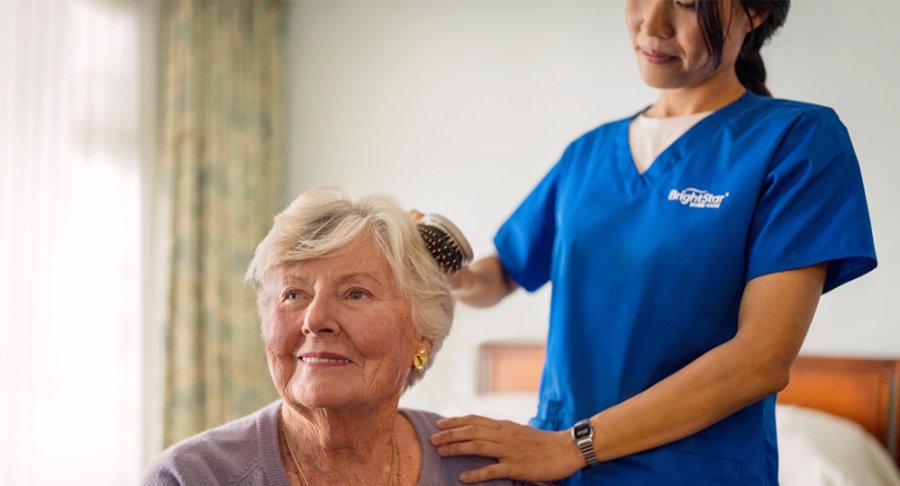
When an older adult resists the idea of a caregiver coming to their home, or refuses to let family members help with tasks they are clearly struggling with, it is tempting to interpret this as irrationality as a failure to see the obvious, or as stubbornness that needs to be overcome.
That interpretation is almost always wrong, and it leads to approaches that consistently make things worse.
Resistance to help in older adults is almost always about something more fundamental than the specific help being offered. It is about what accepting help means and what it signals about the trajectory the person believes they are on.
It means acknowledging decline. Accepting help from a caregiver is, for many older adults, the moment at which they have to admit to themselves that something has changed. As long as they are managing alone even if managing poorly, even if managing unsafely they can maintain the narrative that things are essentially fine. Accepting help collapses that narrative. It makes the decline real in a way that continuing to struggle, however unreasonably, does not.
It means losing control over the pace of change. Many older adults who resist help are not refusing care itself they are refusing the speed at which they feel things are moving. They did not get to choose the pace of their decline. They did not get to choose when the conversation about help would begin. Resisting is one of the few ways they can assert control over a process that otherwise feels entirely outside their hands.
It means renegotiating a lifelong identity. For a person who has spent seven or eight decades being the competent one the parent who took care of others, the spouse who handled the household, the professional who was relied upon, the person friends called in a crisis accepting help requires becoming, in some fundamental sense, a different kind of person. That renegotiation is not trivial. It takes time. It takes a kind of internal permission that cannot be granted from the outside.
It means trusting a stranger in an intimate space. A caregiver comes into the home the most private space a person occupies and assists with the most intimate activities of daily life. For someone who has always managed these things privately and independently, the prospect of that kind of intimacy with a person they do not know is genuinely confronting. The resistance is not to the help itself. It is to the exposure.
Understanding these underlying dynamics does not make the resistance easier to resolve. But it makes it possible to respond to what is actually happening rather than to a surface-level refusal that makes the conversation feel like a negotiation about tasks when it is really a negotiation about identity.
In-home Care Services Call Us Today
Most families approach the conversation about accepting help with a combination of logic and urgency. They present evidence of the problem, the fall risk, the medications that have been missed, the meals that are not being prepared and they argue for the solution. They explain why help makes sense. They point out that the current situation is not sustainable. They express concern that registers, to the older adult, as pressure.
The problem is that logic and urgency are exactly the wrong tools for a conversation that is not primarily about logic.
A person who is resisting help because accepting it means acknowledging decline does not become more willing to acknowledge decline when family members present evidence of that decline more forcefully. They become more defended. The more pressure that is applied, the more strongly the identity that is being threatened tends to assert itself because backing down under pressure feels, in the moment, even more like a loss of autonomy than the original acceptance would have.
Similarly, expressions of worry "I'm so worried about you," "I can't sleep at night thinking about what might happen," "I need you to do this for me" while entirely genuine, place the older adult in the position of being responsible for the family's anxiety. This often produces guilt, which produces defensiveness, which produces more resistance rather than less.
None of this means the family is wrong to be worried, or wrong to want things to change. It means that the path to change runs through something other than the standard approaches.
This means that wherever genuine choice exists, it should be offered explicitly and honored when exercised. Not the choice of whether to accept any help at all, if safety is genuinely at stake. But the choice of when the caregiver comes, which tasks they help with, what they are called, how they are introduced to neighbors, whether the television is on or off during their visit. These choices feel small from the outside. From the inside, they are the difference between an arrangement that has been accepted and one that is merely being tolerated.
Families who can begin the conversation before a crisis when nothing has just gone wrong, when the stakes feel lower, when the older adult is not in a physiologically activated state have a meaningfully better chance of making progress. This requires recognizing the signs of increasing need before they become acute, and having the courage to raise a difficult subject before it becomes urgent.
The second framing is not spin. For many older adults, the right level of support genuinely does free up energy and capacity for the things that matter most to them. But the framing has to reflect that reality, not simply repackage the same message in softer language.
If the physician is aware of the situation and agrees that additional support is warranted, a direct conversation in which the physician recommends it and can answer clinical questions the patient may have is often more effective than any number of family discussions.
Families who approach this as a process rather than a negotiation that needs to be won, who continue to show up, continue to express concern without pressure, continue to offer options without demanding decisions are more likely to reach a place where the older adult arrives at acceptance in a way that feels, to them, like their own choice.
That is not always possible. Sometimes safety requires moving faster than the psychological process allows. But when safety permits a longer timeline, the longer timeline almost always produces better outcomes for the older adult and for the family relationship.
In-home Care Services Call Us Today
There is a reframe at the center of this conversation that, when it lands, tends to change things.
Independence is not the absence of help. Independence is the ability to live according to your own values, preferences, and priorities to remain the author of your own life.
A person who accepts help with bathing and dressing so that they have the energy to spend the afternoon in their garden, or reading, or talking on the phone with their grandchildren, is not less independent than a person who struggles through those tasks alone and then has nothing left. They are arguably more independent because the help has expanded what is available to them, not contracted it.
This reframe does not work for everyone, and it does not work the first time it is offered. But for older adults who are genuinely wrestling with what accepting help means for their sense of self, the idea that help can be a tool for independence rather than evidence of its loss sometimes opens a door that logic and urgency cannot.
Contact Us Today:
We work regularly with clients who were not ready when care began who accepted it reluctantly, on limited terms, with significant conditions attached. We know that the first few weeks of a care relationship often require as much patience as clinical skill. We take the matching of caregiver to client seriously, because the right person can build the trust that makes everything else possible. And we take our cue from the client about the pace at which care expands, rather than treating the initial care plan as a negotiation to be won.
If your family is trying to help a loved one accept support and finding the conversation difficult, we are glad to be a resource not just for the care itself, but for thinking through how to approach a conversation that matters.
When safety is genuinely at risk when the older adult's refusal to accept help is creating conditions that could result in serious harm families and physicians sometimes face decisions that involve overriding a preference. These decisions are among the hardest in caregiving and often involve clinical, legal, and ethical dimensions that benefit from professional guidance. For most situations that fall short of acute safety crisis, however, giving the psychological process the time it needs produces better outcomes than forcing a resolution. A care arrangement that the older adult has arrived at themselves even slowly is one they are far more likely to sustain and benefit from.
BrightStar Care of Baraboo provides skilled nursing and non-medical home care services for older adults and their families throughout Baraboo, Reedsburg, Wisconsin Dells, Portage, Sauk City, Prairie du Sac, and surrounding Sauk County communities. If your family is navigating a difficult conversation about accepting care, we are here to help. Contact our Baraboo office today.
In-home Care Services Call Us Today
This fear is not irrational. It reflects something real about what independence has meant across a lifetime: the accumulated evidence of competence, the sense of being a person who handles things, the dignity of managing one's own life without requiring others to manage it for you. When aging begins to threaten that, the psychological response is not simply stubbornness or denial. It is grief, and it is identity threat, and it deserves to be understood as such.
For families in Baraboo, Reedsburg, Wisconsin Dells, Portage, Sauk City, and throughout Sauk County who are trying to help an aging parent or loved one accept support and finding that the conversation keeps going nowhere this post is written for you. Not with easy answers, because they do not exist. But with a clearer picture of what is actually happening psychologically, and what approaches have the best chance of genuinely working.
What Resistance to Help Is Really About
When an older adult resists the idea of a caregiver coming to their home, or refuses to let family members help with tasks they are clearly struggling with, it is tempting to interpret this as irrationality as a failure to see the obvious, or as stubbornness that needs to be overcome.That interpretation is almost always wrong, and it leads to approaches that consistently make things worse.
Resistance to help in older adults is almost always about something more fundamental than the specific help being offered. It is about what accepting help means and what it signals about the trajectory the person believes they are on.
It means acknowledging decline. Accepting help from a caregiver is, for many older adults, the moment at which they have to admit to themselves that something has changed. As long as they are managing alone even if managing poorly, even if managing unsafely they can maintain the narrative that things are essentially fine. Accepting help collapses that narrative. It makes the decline real in a way that continuing to struggle, however unreasonably, does not.
It means losing control over the pace of change. Many older adults who resist help are not refusing care itself they are refusing the speed at which they feel things are moving. They did not get to choose the pace of their decline. They did not get to choose when the conversation about help would begin. Resisting is one of the few ways they can assert control over a process that otherwise feels entirely outside their hands.
It means renegotiating a lifelong identity. For a person who has spent seven or eight decades being the competent one the parent who took care of others, the spouse who handled the household, the professional who was relied upon, the person friends called in a crisis accepting help requires becoming, in some fundamental sense, a different kind of person. That renegotiation is not trivial. It takes time. It takes a kind of internal permission that cannot be granted from the outside.
It means trusting a stranger in an intimate space. A caregiver comes into the home the most private space a person occupies and assists with the most intimate activities of daily life. For someone who has always managed these things privately and independently, the prospect of that kind of intimacy with a person they do not know is genuinely confronting. The resistance is not to the help itself. It is to the exposure.
Understanding these underlying dynamics does not make the resistance easier to resolve. But it makes it possible to respond to what is actually happening rather than to a surface-level refusal that makes the conversation feel like a negotiation about tasks when it is really a negotiation about identity.
In-home Care Services Call Us Today
Why the Standard Approaches Often Fail
Most families approach the conversation about accepting help with a combination of logic and urgency. They present evidence of the problem, the fall risk, the medications that have been missed, the meals that are not being prepared and they argue for the solution. They explain why help makes sense. They point out that the current situation is not sustainable. They express concern that registers, to the older adult, as pressure.The problem is that logic and urgency are exactly the wrong tools for a conversation that is not primarily about logic.
A person who is resisting help because accepting it means acknowledging decline does not become more willing to acknowledge decline when family members present evidence of that decline more forcefully. They become more defended. The more pressure that is applied, the more strongly the identity that is being threatened tends to assert itself because backing down under pressure feels, in the moment, even more like a loss of autonomy than the original acceptance would have.
Similarly, expressions of worry "I'm so worried about you," "I can't sleep at night thinking about what might happen," "I need you to do this for me" while entirely genuine, place the older adult in the position of being responsible for the family's anxiety. This often produces guilt, which produces defensiveness, which produces more resistance rather than less.
None of this means the family is wrong to be worried, or wrong to want things to change. It means that the path to change runs through something other than the standard approaches.
What the Research and Clinical Experience Suggest Actually Works
Preserve the Sense of Control Wherever Possible
The most consistent finding in research on help acceptance in older adults is that autonomy the sense that the person is making choices rather than having choices made for them is the primary variable. Older adults who experience the help arrangement as something they chose are significantly more able to accept it than those who experience it as something that happened to them.This means that wherever genuine choice exists, it should be offered explicitly and honored when exercised. Not the choice of whether to accept any help at all, if safety is genuinely at stake. But the choice of when the caregiver comes, which tasks they help with, what they are called, how they are introduced to neighbors, whether the television is on or off during their visit. These choices feel small from the outside. From the inside, they are the difference between an arrangement that has been accepted and one that is merely being tolerated.
Separate the Conversation From the Crisis
The hardest version of the help-acceptance conversation is the one that happens immediately after something has gone wrong a fall, a concerning phone call, a visit that revealed conditions the family was not prepared for. The urgency is real, the family's anxiety is understandable, and the older adult is in the most defended position they are likely to occupy.Families who can begin the conversation before a crisis when nothing has just gone wrong, when the stakes feel lower, when the older adult is not in a physiologically activated state have a meaningfully better chance of making progress. This requires recognizing the signs of increasing need before they become acute, and having the courage to raise a difficult subject before it becomes urgent.
Name It As an Addition, Not a Replacement
The framing of help matters enormously. Help that is presented as a replacement for what the older adult can no longer do "you can't manage the cooking anymore, so we're going to have someone come in" is received as confirmation of loss. Help that is presented as an addition to what they are already doing "we thought having someone come in to help with the cooking would free up your energy for the things you actually enjoy" is received differently.The second framing is not spin. For many older adults, the right level of support genuinely does free up energy and capacity for the things that matter most to them. But the framing has to reflect that reality, not simply repackage the same message in softer language.
Involve the Person's Physician
For many older adults, the primary care physician occupies a different category of authority than family members. A recommendation from a doctor that the patient accepts some additional support at home carries weight that the same recommendation from an adult child does not. This is not a manipulation it is an accurate reflection of the relational dynamic, and using it appropriately is reasonable.If the physician is aware of the situation and agrees that additional support is warranted, a direct conversation in which the physician recommends it and can answer clinical questions the patient may have is often more effective than any number of family discussions.
Give It Time
The most important thing families can do and the hardest is to resist the urgency that makes them want the conversation to be resolved quickly. Acceptance of help rarely happens in a single conversation. It happens in a series of conversations over weeks and months, each one moving slightly further, each one building the trust and the internal permission that eventually make acceptance possible.Families who approach this as a process rather than a negotiation that needs to be won, who continue to show up, continue to express concern without pressure, continue to offer options without demanding decisions are more likely to reach a place where the older adult arrives at acceptance in a way that feels, to them, like their own choice.
That is not always possible. Sometimes safety requires moving faster than the psychological process allows. But when safety permits a longer timeline, the longer timeline almost always produces better outcomes for the older adult and for the family relationship.
In-home Care Services Call Us Today

The Reframe That Changes Everything
There is a reframe at the center of this conversation that, when it lands, tends to change things.Independence is not the absence of help. Independence is the ability to live according to your own values, preferences, and priorities to remain the author of your own life.
A person who accepts help with bathing and dressing so that they have the energy to spend the afternoon in their garden, or reading, or talking on the phone with their grandchildren, is not less independent than a person who struggles through those tasks alone and then has nothing left. They are arguably more independent because the help has expanded what is available to them, not contracted it.
This reframe does not work for everyone, and it does not work the first time it is offered. But for older adults who are genuinely wrestling with what accepting help means for their sense of self, the idea that help can be a tool for independence rather than evidence of its loss sometimes opens a door that logic and urgency cannot.
Contact Us Today:
- Phone: 608-355-5015
- Address: 502 Oak St. Offices 6 & 7, Baraboo, WI 53913
- Visit Us Online: BrightStar Care of Baraboo
How BrightStar Care of Baraboo Works With Resistant Clients
At BrightStar Care of Baraboo, we provide both skilled nursing and non-medical home care for older adults and their families throughout Baraboo, Reedsburg, Wisconsin Dells, Portage, Sauk City, Prairie du Sac, and surrounding Sauk County communities.We work regularly with clients who were not ready when care began who accepted it reluctantly, on limited terms, with significant conditions attached. We know that the first few weeks of a care relationship often require as much patience as clinical skill. We take the matching of caregiver to client seriously, because the right person can build the trust that makes everything else possible. And we take our cue from the client about the pace at which care expands, rather than treating the initial care plan as a negotiation to be won.
If your family is trying to help a loved one accept support and finding the conversation difficult, we are glad to be a resource not just for the care itself, but for thinking through how to approach a conversation that matters.
Frequently Asked Questions
Q: Why do so many older adults resist accepting help even when they clearly need it?
Resistance to help in older adults is rarely about the specific help being offered. It is typically about what accepting help means acknowledging decline, losing control over the pace of change, renegotiating a lifelong identity built around competence and self-sufficiency, and tolerating the intimacy of a stranger in a private space. Understanding these underlying dynamics changes how families approach the conversation from a negotiation about tasks to a more sensitive engagement with identity, autonomy, and grief.Q: What is the most effective approach for helping a resistant older adult accept home care?
The approaches most consistently supported by research and clinical experience are: preserving autonomy by offering genuine choices wherever possible; introducing the conversation before a crisis rather than in the middle of one; framing help as an addition to what the person can do rather than a replacement for what they cannot; involving the primary care physician when appropriate; and allowing the process to unfold over time rather than expecting resolution in a single conversation. Pressure and urgency consistently backfire not because the concern behind them is wrong, but because the psychological dynamic they activate produces defensiveness rather than openness.
Q: Is it ever appropriate to override an older adult's refusal to accept help?
When safety is genuinely at risk when the older adult's refusal to accept help is creating conditions that could result in serious harm families and physicians sometimes face decisions that involve overriding a preference. These decisions are among the hardest in caregiving and often involve clinical, legal, and ethical dimensions that benefit from professional guidance. For most situations that fall short of acute safety crisis, however, giving the psychological process the time it needs produces better outcomes than forcing a resolution. A care arrangement that the older adult has arrived at themselves even slowly is one they are far more likely to sustain and benefit from.BrightStar Care of Baraboo provides skilled nursing and non-medical home care services for older adults and their families throughout Baraboo, Reedsburg, Wisconsin Dells, Portage, Sauk City, Prairie du Sac, and surrounding Sauk County communities. If your family is navigating a difficult conversation about accepting care, we are here to help. Contact our Baraboo office today.
In-home Care Services Call Us Today