
Of all the changes a stroke can bring, few are lonelier than aphasia — the loss or disruption of language. The person is fully themselves inside: same intelligence, same memories, same opinions about the Red Sox. What’s damaged is the wiring between thought and words. Families tell us the hardest part is watching a loved one trapped mid-sentence — and not knowing whether helping or waiting is kinder. At BrightStar Care of Concord, Lexington & Woburn, our caregivers support stroke survivors with aphasia every week; this guide covers what aphasia is, how to communicate better starting today, and how language gets rebuilt.
Key Takeaways
- Aphasia is a language problem, not an intelligence problem — talk to the person as the adult they still fully are.
- There are different patterns: some survivors struggle to produce words but understand well; others speak fluently but comprehend poorly — knowing which changes how you help.
- Time is the gift: slow down, allow long pauses, and resist finishing sentences unless invited.
- Yes/no questions, gestures, writing, and pictures are legitimate communication — use every channel, not just speech.
- Speech-language therapy plus daily conversational practice drives recovery, and improvement can continue for years.
What Aphasia Is — and Isn’t
Aphasia results from damage to the brain’s language regions, usually on the left side. Depending on where the stroke landed, it takes different shapes. In expressive (non-fluent) aphasia, understanding is relatively preserved but producing words is a fight — speech comes in short, effortful bursts, and the person knows exactly what they mean. In receptive (fluent) aphasia, speech flows easily but may carry wrong or invented words, and understanding others is the harder side. Global aphasia affects both directions substantially. Many survivors have mixed pictures, and reading and writing are usually affected alongside speech. What aphasia is not: confusion, dementia, or diminished intellect. That distinction isn’t a nicety — it dictates everything about how to interact.
How to Communicate Better — Starting Tonight
- Get the setting right: one conversation partner at a time, TV off, face to face — aphasia plus background noise is language with static.
- Slow down and simplify — without dumbing down: shorter sentences, normal adult tone, one idea at a time. Louder doesn’t help; slower does.
- Give time — real time: pauses of ten, twenty seconds feel eternal and are exactly what the rebuilding brain needs. Jumping in to finish sentences, however lovingly, takes the rep away. Ask once: ‘Want help, or want time?’ — then honor the answer.
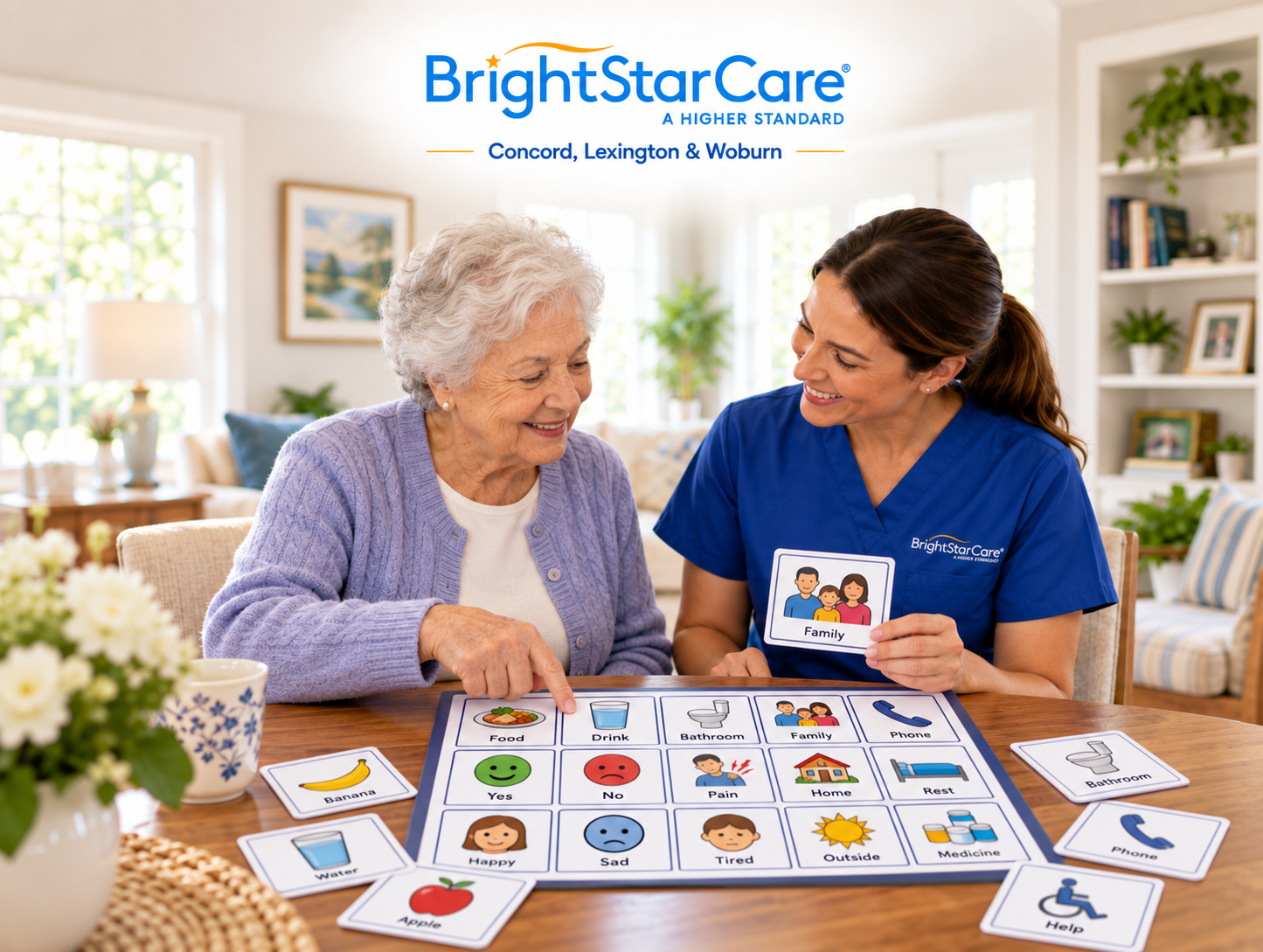
- Open every channel: yes/no and either/or questions lower the load; gestures, pointing, drawing, writing key words, and photo boards all count as talking. Keep paper and marker within reach at all times.
- Confirm, don’t assume: repeat back what you understood (‘Coffee — now?’). With comprehension-side aphasia, watch faces, not nods — nodding often means politeness, not understanding.
- Keep them in the room: include the person in conversations and decisions happening around them, and never discuss them in the third person while present. Aphasia already isolates; family habits decide how much.
How Language Gets Rebuilt
Speech-language pathology (SLP) is the engine of aphasia recovery — assessment of the specific pattern, then targeted therapy: word-retrieval drills, scripted conversations, melodic techniques that recruit the brain’s intact music pathways, and training for the family as communication partners (which research supports as genuinely effective). Two truths to hold: gains are typically strongest in the early months, and improvement can continue for years with continued practice — late progress is real progress. Between sessions, daily conversational practice is the therapy multiplier: reading headlines aloud together, naming groceries while unpacking, structured chat over coffee. Practice partners matter — which is exactly the role our caregivers play in many local homes, turning ordinary daily care into dozens of low-pressure language reps.
The Emotional Weight — Both Directions
Depression and frustration are common companions of aphasia — imagine every sentence as a locked door — and they deserve the same medical attention as the language itself, because mood powerfully affects therapy engagement. Watch for withdrawal, given how much easier silence becomes than struggle. And name the caregiver’s side too: conversation was the relationship’s daily bread, and its disruption is a genuine loss worth grieving and adapting to — support groups for both survivors and families exist for good reason. Connection survives aphasia; it just changes vehicles — shared activities, touch, humor, music, and presence carry what words temporarily can’t.
“The biggest gift a family can give someone with aphasia costs nothing: the pause. Count to fifteen in your head before you help. It will feel unbearable the first week. By the second month you’ll watch the words start arriving in that space you learned to leave.”
— Speech-support perspective shared with families we support
Coffee-table therapy in a Lexington kitchen
A retired Lexington teacher — a man who’d spent forty years talking for a living — came home from his stroke with severe expressive aphasia and, within weeks, a new silence his wife found more frightening than the stroke itself: he’d stopped trying. Our caregiver, briefed by his speech therapist, rebuilt talking into the day’s furniture: headlines read aloud over breakfast, either/or choices at every meal, a marker and pad that lived on the coffee table, and the agreed fifteen-second pause his wife practiced until it stopped feeling cruel. Six months later his sentences were short and hard-won — and daily. ‘He argues with the sports page again,’ his wife told our nurse. ‘Three words at a time. It’s the best sound in the house.’
Frequently Asked Questions
Does aphasia mean his thinking and memory are damaged too?
Aphasia itself is a language disorder — intelligence, memory, and personality are not what it damages, and many survivors describe fully intact thoughts trapped behind the word barrier. That said, a stroke can separately affect attention, memory, or processing depending on its territory, so a neuropsychological picture from the care team is worth having. The operating rule at home stays the same either way: assume competence, speak adult-to-adult, and let the person prove what they understand rather than deciding for them.
How long does aphasia recovery take — and does it ever fully resolve?
Every aphasia is different. Some resolve substantially in weeks to months; others improve steadily for years and plateau with lasting differences; the early months typically bring the fastest gains. Two things are consistently true: continued therapy and daily practice extend improvement far past the old timelines, and ‘recovery’ rightly includes mastering compensations — gestures, writing, technology — that restore communication even where speech lags. Ask the SLP for goals in capabilities, not calendars.
What technology actually helps?
Plenty, matched to the pattern: text-to-speech and picture-based communication apps on a tablet give expressive-aphasia survivors a voice for hard moments; speech-therapy practice apps add reps between sessions; and simple tools — a phone’s photo album as a pointing board, voice assistants for calls and lights — lower daily friction. Let the speech-language pathologist prescribe the toolkit; the wrong app frustrates, the right one liberates. Our caregivers reinforce whatever system the SLP sets up, every visit.
How BrightStar Care of Concord, Lexington and Woburn Can Help
- Daily communication practice partners. Our caregivers turn routine care into structured language reps, following the speech therapist’s program — part of our in-home care services.
- Skilled nursing for the whole recovery. Aphasia rarely travels alone — our skilled nursing care manages the medications, monitoring, and recovery needs around it.
- Patience as a professional skill. Unrushed care — the pause, the choices, the channel-switching — is trained behavior for our team, not a favor.
The Person Is Still There
Aphasia steals words, not the person — and families who grasp that single fact communicate better by dinnertime. Slow down, open every channel, guard the pause, and keep the daily reps going alongside therapy. The road back to language is long and real. For the broader recovery around it, our roadmap to the first 90 days after a stroke is the companion piece to this one.
Helpful Resources
National Aphasia Association — education, communication guides, and support group directories.
American Stroke Association — Aphasia — stroke-related communication effects explained.
About the Author & Medical Reviewer
This article was prepared by the clinical team at BrightStar Care of Concord, Lexington & Woburn, MA, a home care and skilled nursing provider whose plans of care are supervised by a Registered Nurse and/or Director of Nursing.
Want a trained practice partner in the house?
Our caregivers make every day a therapy day — call 781-516-7739 (24/7) for a complimentary consultation.
BrightStar Care of Concord, Lexington & Woburn, MA318 Bear Hill Road, Suite 1A, Waltham, MA 02451
Phone (24/7): 781-516-7739
Web: Contact our care team | About us
More from our chronic condition care series: The First 90 Days After a Stroke | Preventing a Second Stroke | Living With CHF at Home | Heart Attack Home Recovery