
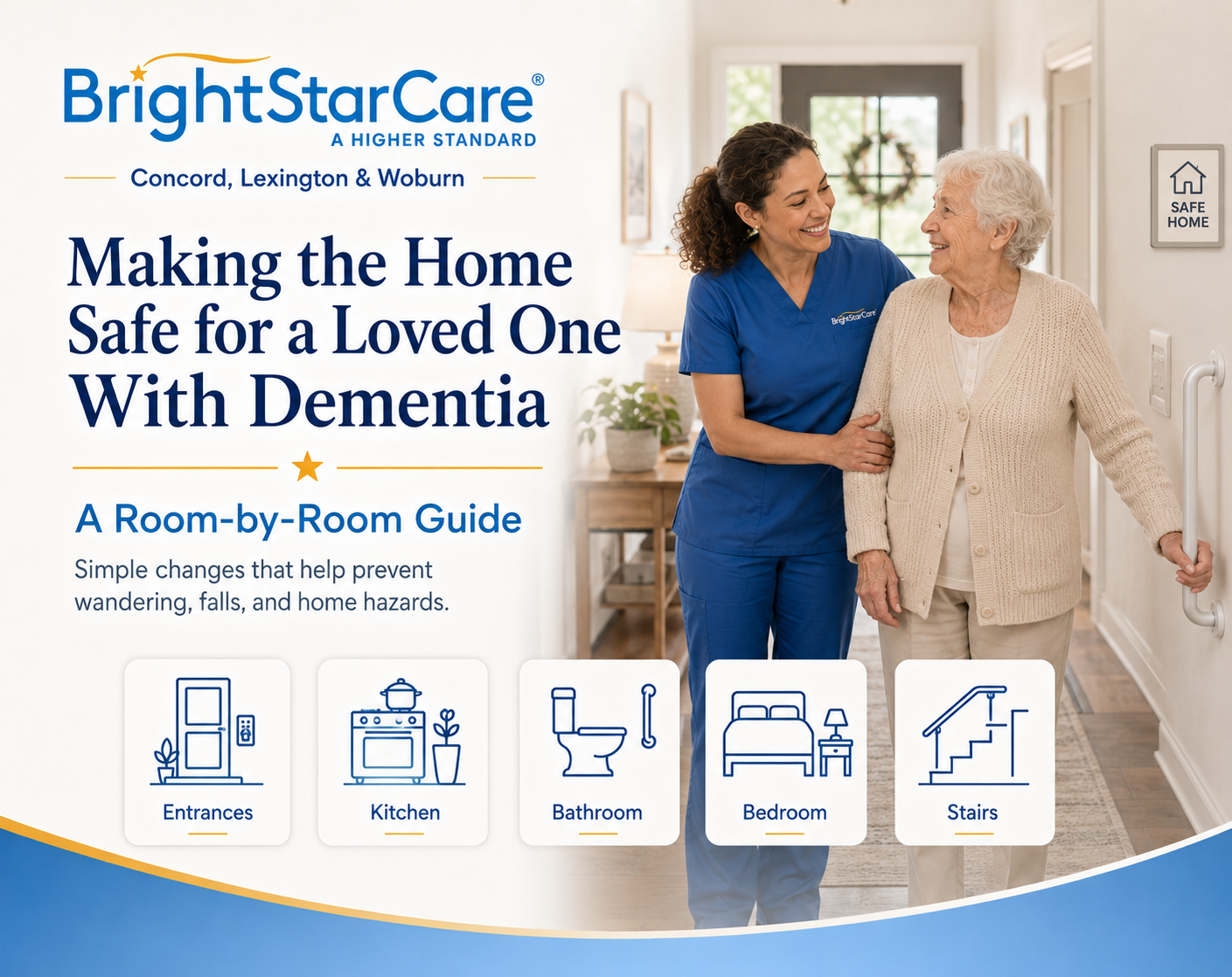
Keeping a loved one with dementia at home — the goal of nearly every family we meet — depends on one unglamorous project: making the home itself safe as abilities change. The good news is that most of what works is inexpensive, and much of it takes a weekend. This room-by-room guide from BrightStar Care of Concord, Lexington & Woburn covers the changes our nurses recommend most often in local homes, ordered the way we walk a house: from the front door inward.
Key Takeaways
- Safety needs change as dementia progresses — re-walk this checklist every few months, not once.
- The highest-impact, lowest-cost trio: better lighting, secured exits, and a safer stove.
- Falls and wandering cause most dementia home emergencies; both are largely preventable with environmental changes.
- Remove hazards quietly rather than announcing restrictions — dignity-preserving changes meet less resistance.
- A professional walk-through catches what family eyes have stopped seeing; an RN home-safety review is part of every BrightStar Care assessment.
Entrances and Exits: Wandering Prevention First
- Add a second lock well above or below eye level on exterior doors — out of the habitual sight line — and keep keys off visible hooks.
- Use inexpensive door chimes or smart sensors so no exit goes unnoticed, especially overnight.
- Camouflage works: a curtain over the door or a dark doormat (often perceived as a hole) reduces exit-seeking without confrontation.
- Prepare for the breach anyway: an ID bracelet, a recent photo on hand, and consider a wearable GPS locator for anyone with wandering history.
Kitchen: Contain the Highest-Risk Room
- Install an automatic stove shut-off or remove stove knobs between meals — the single most important kitchen change.
- Lock away knives, cleaning chemicals, alcohol, and medications; move daily-use items to one predictable, reachable shelf.
- Use kettles and appliances with auto-off; unplug rarely-used ones. Check the fridge weekly for spoiled food.
Bathroom: Where Most Falls Happen
- Grab bars at the toilet and in the shower (anchored to studs — towel bars are not grab bars), plus a shower chair and handheld sprayer.
- Non-slip mats inside and outside the tub; contrasting-color toilet seat and bath mat so fixtures are visible against white-on-white.
- Set the water heater to 120°F or below to prevent scalds, and remove or disable the door lock so no one gets locked in.
Bedroom: Nights Are the Risk Window
- Motion-activated night lights tracing the bed-to-bathroom path — most nighttime falls happen on exactly this route.
- Clear the floor: no cords, no clutter, no throw rugs; keep the path straight and wide.
- Bed at a height where feet reach the floor when seated; a bedside commode late in the disease can eliminate the riskiest trip entirely.
Stairs and Hallways
- Bright, even lighting top and bottom, with switches at both ends; high-contrast tape on stair edges makes each step legible.
- Sturdy handrails on both sides; gates at the top of stairs if judgment or balance has declined; remove every loose runner.
Whole-Home Changes That Punch Above Their Weight
- Light against shadows: shadows and dim rooms feed evening confusion — lamps on timers before dusk help safety and sundowning alike.
- Reduce reflections: cover or remove mirrors that cause distress (an unrecognized reflection can read as an intruder) and glare-prone glass.
- Lock all medications in one place — including over-the-counter bottles — and post emergency numbers plus your address by every phone.
- Declutter walkways ruthlessly; in dementia, every object on the floor is a fall waiting for a foot.
Then Walk It Again in Three Months
The house that’s safe for early-stage dementia is not the house late-stage dementia needs. Put a recurring reminder on the calendar and re-walk this list quarterly — or let a professional do it with fresh eyes. A home-safety review by a Registered Nurse is part of every BrightStar Care assessment, and it routinely catches the hazards familiarity has hidden from the family.
A weekend that changed one Woburn ranch house
When our nurse walked a Woburn ranch home with the family of a man in mid-stage Alzheimer’s, the list came to eleven items — nine of them under fifty dollars. The family spent one weekend installing motion night lights, grab bars, stair tape, a stove shut-off, and a door chime, and moved his medications to a locked box. The overnight bathroom stumbles stopped with the lit pathway, and the door chime caught his one exit attempt that winter — at 2 AM in January — before he reached the sidewalk. (Representative example of how we support local families)
Frequently Asked Questions
We’re on a tight budget — where do we start?
Three moves cover the most risk for the least money: motion night lights on the bed-to-bathroom path, removing every throw rug and cord from walkways, and disabling the stove between meals (pulling knobs costs nothing). Add a door chime — typically under 30 dollars — if wandering is any concern at all.
Should we install cameras to keep an eye on things?
Cameras can add real safety — especially for checking on someone living alone — but weigh dignity and consent: place them in common areas rather than bathrooms or bedrooms, and involve your loved one in the conversation to the extent the disease allows. Cameras observe an emergency; they don’t prevent one, so treat them as a supplement to supervision, never a substitute.
How do we prevent wandering without making the house feel like a lockup?
Layer gentle measures: high/low secondary locks, chimes, visual camouflage on doors — combined with the real fix, which is meeting the need underneath. Wandering usually expresses boredom, anxiety, or a searched-for purpose; structured daily engagement dramatically reduces the urge. Supervision during high-risk windows (late day, overnight) closes the remaining gap.
How BrightStar Care of Concord, Lexington and Woburn Can Help
- RN home-safety assessment. Every plan of care starts with a nurse walking your home and delivering a prioritized, budget-aware safety list.
- Supervision for the risk windows. Evening and overnight caregivers cover the hours when wandering and falls actually happen — see our Alzheimer’s and dementia care services.
- Engagement that prevents wandering. Our caregivers use structured daily activity — like the routines in our activities guide — to address the restlessness that drives exit-seeking.
A Safer House Buys Time at Home
Every hazard you remove extends how long “we want to stay home” remains a realistic plan. Do the weekend version of this list now, calendar the quarterly re-walk, and when you want professional eyes on it, we’re nearby. For the full picture of keeping a loved one with dementia at home, start with our family’s guide to Alzheimer’s and dementia home care.
Helpful Resources
National Institute on Aging — Home Safety and Alzheimer’s Disease — comprehensive federal home-safety guidance.
Alzheimer’s Association — Safety — wandering, driving, and home safety resources plus the 24/7 Helpline (1-800-272-3900).
About the Author & Medical Reviewer
This article was prepared by the dementia care team at BrightStar Care of Concord, Lexington & Woburn, MA, a home care and skilled nursing provider whose plans of care are supervised by a Registered Nurse and/or Director of Nursing.
Want a professional walk-through of your home?
An RN home-safety review is part of our complimentary assessment — call 781-516-7739 (24/7) to schedule.
BrightStar Care of Concord, Lexington & Woburn, MA318 Bear Hill Road, Suite 1A, Waltham, MA 02451
Phone (24/7): 781-516-7739
Web: Contact our care team | About us
Explore the full Alzheimer’s & dementia home care series: The Family’s Guide (pillar) · 12 Daily Activities · Sundowning · 9 Signs It’s Time · Respite Care · A Family’s Story