
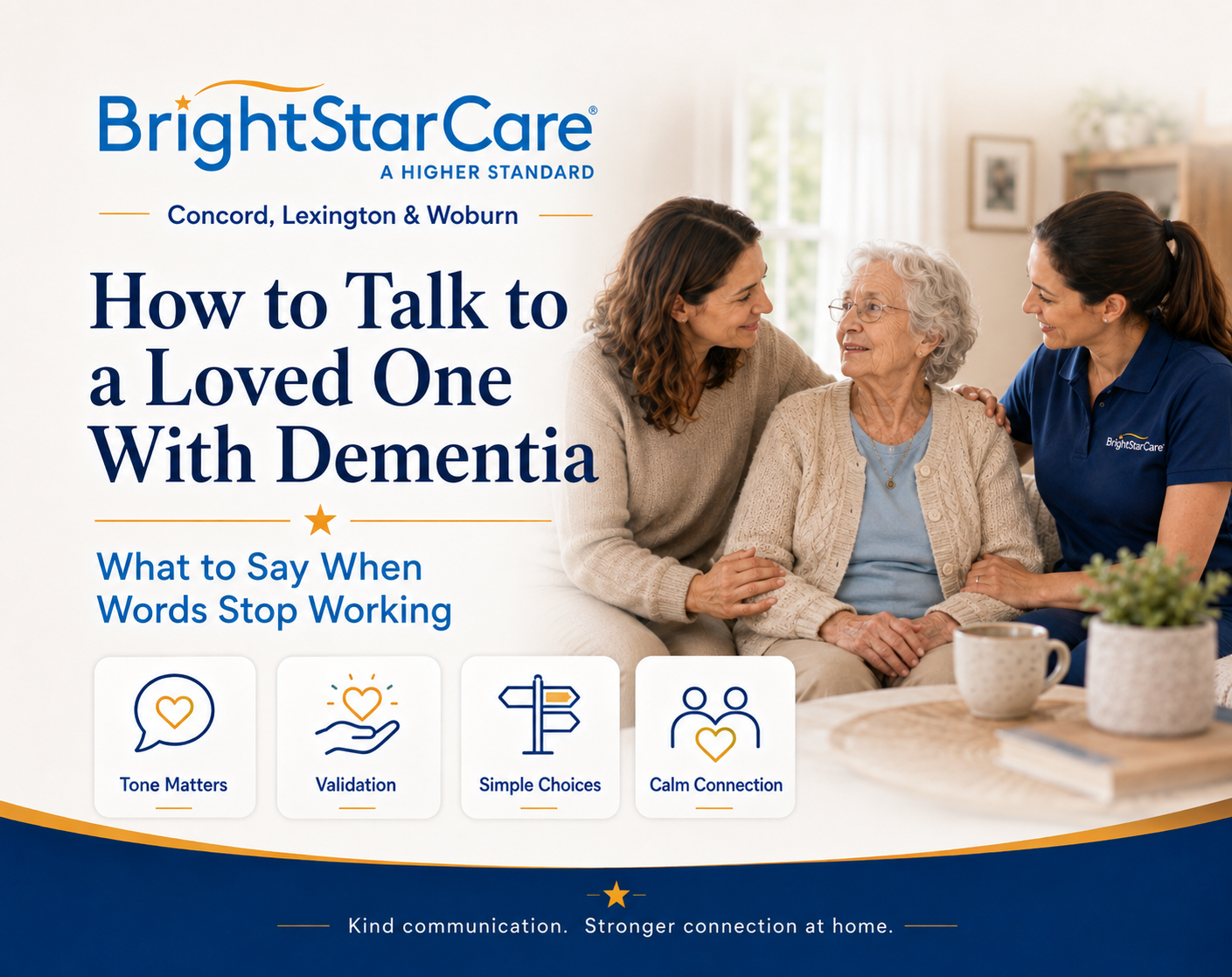
Of everything dementia takes, conversation may be the loss families feel most — the person is right there, and yet the old back-and-forth keeps breaking down into corrections, arguments, and hurt silences. Here’s what our dementia-trained caregivers at BrightStar Care of Concord, Lexington & Woburn know from thousands of home visits: communication doesn’t end with dementia — it changes rules. Learn the new rules, and connection comes back.
Key Takeaways
- In dementia, emotional communication outlives verbal communication — your tone, face, and calm carry more meaning than your words.
- Correcting facts (“No, Mom, Dad died ten years ago”) causes fresh pain without improving memory; join their reality and respond to the feeling instead.
- One idea per sentence, questions with two choices instead of open-ended ones, and patience with long pauses transform most conversations.
- Arguments with dementia are unwinnable by design — redirection beats reasoning every time.
- When words fail entirely, touch, music, and simply sitting together are communication too.
The Rule That Changes Everything: Respond to the Feeling, Not the Facts
When your mother asks where her mother is, she isn’t testing her memory — she’s expressing a need: for comfort, safety, someone who loves her. “Grandma’s not here right now — tell me about her. What was she like in the kitchen?” honors the feeling and often opens a warm memory. “Mom, Grandma died in 1994” delivers grief as breaking news, sometimes several times a day. This approach — often called validation — isn’t lying; it’s answering the question actually being asked.
The Mechanics: Small Changes, Big Difference
- Approach from the front, at eye level, and say who you are without quizzing (“Hi Dad, it’s John, your son” beats “Do you know who I am?”).
- One idea per sentence. “Let’s put on your coat. Now your shoes. We’re going to see Dr. McCabe” — not all three at once.
- Trade open questions for two choices. “Soup or a sandwich?” succeeds where “What do you want for lunch?” overwhelms.
- Wait longer than feels natural. Processing takes time now; count silently to ten before repeating — and repeat with the same words, not louder ones.
- Cut the background noise. Turn off the TV before important conversations; competing sound is competing static.
- Watch your body. Slow movements, soft tone, a smile — people with dementia read your emotional weather with startling accuracy long after words blur.
What to Stop Saying
- “Remember when…?” — replace with “I was thinking about the time…”, which shares a memory without demanding one.
- “I just told you that.” — for them, each asking is the first; answer as if it is.
- “You can’t / Don’t…” — commands invite battle; invitations (“Come help me with this”) redirect without confrontation.
- “That’s not true.” — you will not win an argument with dementia; you can only both lose it. Redirect to a task, a snack, a walk, a song.
When Words Run Out
In the later stages, verbal language may go almost entirely — and communication continues. Holding a hand through a hand massage, playing the music of their younger years, looking through photographs together, sitting in shared quiet: these carry “I’m here, you’re safe, you’re loved” perfectly. Many of the failure-free approaches in our activities guide are, at heart, conversations without words.
“Families think the goal is keeping the conversation accurate. The goal is keeping it kind. I’ve never seen a person with dementia remember being corrected — but they hold onto how the correction felt for hours.”
— Dementia care perspective shared with families we support
The question one Concord husband stopped answering with facts
A Concord man’s wife asked for her mother a dozen times a day, and each honest answer — gone thirty years — brought fresh tears, his and hers. Our caregiver modeled a different reply: “She’s not here right now — was she the one who taught you to bake?” The question stopped being a wound and became a doorway; within weeks he had heard stories about his mother-in-law’s kitchen he’d never known, and the daily tears on both sides had largely stopped. (Representative example of how we support local families)
Frequently Asked Questions
Isn’t going along with their reality just lying to them?
Think of it as answering the real question. “Where is my mother?” asked by someone who cannot retain the fact of her death is a request for comfort, not information. Meeting the emotional need is honest to what matters — and repeatedly re-announcing a death they cannot process inflicts grief without any offsetting benefit. Most dementia care experts, including the Alzheimer’s Association, endorse this approach.
What do we do when they get angry mid-conversation?
Stop the current thread — don’t defend, explain, or persist. Lower your voice, slow down, create physical space if needed, and redirect to something concrete: a drink, a walk, a task, music. Anger in dementia is usually overwhelm wearing a mask; removing the overwhelm removes most of the anger. If aggression is new or escalating, mention it to their physician.
How do we handle phone and video calls as the disease progresses?
Shorter, more frequent, and more structured beats long and open-ended: call at their best time of day, open by naming yourself, ask two-choice questions, and don’t fight silences. On video, good lighting on your face matters more than anything you say. When calls stop working, a caregiver on-site can bridge — holding the phone, prompting gently, and relaying what the call couldn’t.
How BrightStar Care of Concord, Lexington and Woburn Can Help
- Caregivers trained in dementia communication. Validation, redirection, and de-escalation are core skills in BrightStar Care’s Alzheimer’s and Dementia Care Path — see our dementia care services.
- Coaching for the family. Our caregivers model these techniques in your home, so the whole family learns the new rules by watching them work.
- Connection built into every visit. Conversation, reminiscence, and music aren’t extras in our plans of care — they’re scheduled, like everything that matters.
The Conversation Isn’t Over — It’s Different
You will likely never again debate politics or plan a trip together the old way. But warmth, laughter, comfort, and understanding remain available at every stage — for families who learn to speak dementia’s language. For the complete picture of supporting a loved one at home, start with our family’s guide to Alzheimer’s and dementia home care.
Helpful Resources
Alzheimer’s Association — Communication and Alzheimer’s — stage-by-stage communication guidance and the 24/7 Helpline (1-800-272-3900).
National Institute on Aging — Communicating With Someone Who Has Alzheimer’s — evidence-based communication tips.
About the Author & Medical Reviewer
This article was prepared by the dementia care team at BrightStar Care of Concord, Lexington & Woburn, MA, a home care and skilled nursing provider whose plans of care are supervised by a Registered Nurse and/or Director of Nursing.
Want caregivers who speak dementia’s language?
Call 781-516-7739 (24/7) for a complimentary consultation with our dementia-trained team.
BrightStar Care of Concord, Lexington & Woburn, MA
318 Bear Hill Road, Suite 1A, Waltham, MA 02451
Phone (24/7): 781-516-7739
Web: Contact our care team | About us
More from our Alzheimer’s & dementia care series: The Family’s Guide (pillar) · Mealtime & Nutrition · The First Year After Diagnosis · Understanding Dementia Behaviors · Long-Distance Caregiving · Types of Dementia