
.png "BrightStar-RN-Led-Home-Care-Featured-(1).png")
Most families comparing home care agencies end up holding two or three quotes that look almost the same. Similar rates, similar promises, similar language on the website. But only some of them mention nurse supervision.
Almost none of those explain what that means.
It matters, because the real question underneath the decision is simpler than anything on those quotes. Someone is going to be alone in your parent's house for hours at a time. Who is watching, supervising, guiding?
RN-led home care means a registered nurse builds your parent's personalized plan of care, oversees the caregivers who carry it out, and stays accountable for the case for as long as care continues. That is the model on every in-home care case we take at BrightStar Care, not an upgrade you pay extra for. Here is what it looks like in practice, and what to ask any agency you are considering.
What happens before care starts?
A registered nurse comes to the home on day one of care. There is no charge for the visit and the assessment.
The nurse meets your parent, meets you and anyone else in the family who wants to be there. She walks the house looking at what causes problems later: the stairs, the bathroom, the hallway lighting at night, the throw rug at the top of the landing, and whether the current system for taking medications is working.
She asks about the day. What time your mother gets up, what she can still do herself, what has gotten harder lately, and what she will absolutely refuse to let anyone help with. That last one comes up in every house, and it is better to know on day zero than day three.
Then the caregiver is introduced as care begins. That matters more than it sounds. Nobody should be meeting a stranger at the door on the first morning.
What is a plan of care, and why does it matter?
A plan of care is a written document the nurse builds out of that visit. It is specific to your parent, and it is what the caregiver works from.
A generic task list says assist with bathing. A Brightstar Care plan of care says how your father prefers to be helped, which side is weaker, that he gets unsteady standing up too fast, and what to do on the mornings he says no.
A caregiver who understands a real plan is useful on day one. One who arrives with a generic task list spends two weeks guessing, and your parent feels every bit of that.
How often does the nurse come back?
At least every 60 days, at no charge, for as long as care continues.
Sooner when something happens. Specifically:
- If your parent is hospitalized, the nurse reassesses at discharge, when care picks back up.
- If there is a material change in condition.
- If you, your parent, or another family member raises a concern.
That last one is worth reading twice. You do not have to wait for the calendar. If something feels off, you call and a nurse comes out. Most families have no idea that is available to them.
Who is supervising the caregiver in the house?
The registered nurse.
Care notes come in from the shifts and the nurse reviews them. That is how a slow change gets caught. One note about a skipped breakfast is nothing. The same note four times in ten days is a conversation with the family, and often a reason to call the physician.
When a caregiver is new to a case, whether permanently or covering a single shift, the nurse provides the plan of care. They are not walking in cold and improvising off whatever the last person wrote down.
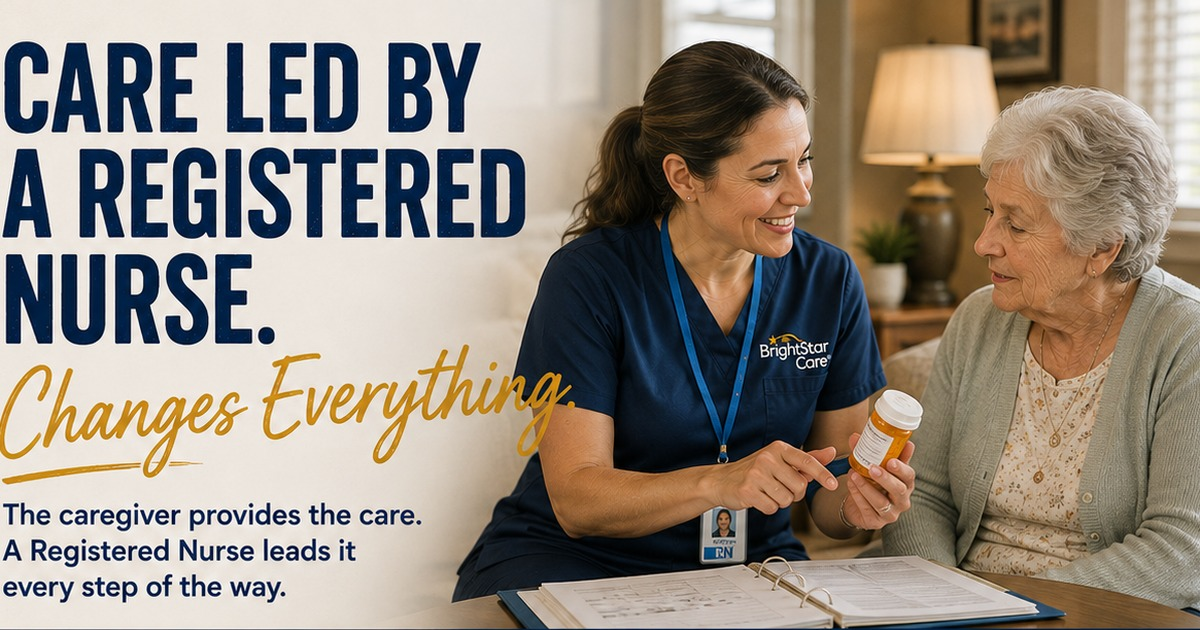
And when a specific need or concern comes up, the nurse engages on it directly. Not a scheduler passing along a message. The nurse who knows the case. That is how our care team works: the caregiver provides the care, and a registered nurse leads it.
Every caregiver we send is a W2 employee, screened and trained and working under that oversight. We employ about 300 of them (both aides and nurses) across the four counties we serve.
Where does RN oversight matter most?
On the cases with the most hours.
When someone comes four hours a week, not much changes between nurse visits. On a live-in or 24-hour case, your parent is being cared for through the nights, the medication changes, and the weeks after a hospital stay. Conditions move, and the plan has to move with them.
The same goes for skilled nursing cases. Wound care, a new drain or feeding tube, complicated medication, recovery after surgery. These are the situations where families feel most exposed, and where nurse accountability does the most work.
Families choose live-in and 24-hour coverage because being alone is no longer workable. RN oversight is what keeps that level of care from quietly turning into somebody simply being present in the house.
What should you ask any agency you are considering?
Ask all of them the same questions. The answers separate them fast.
- Does a registered nurse do the initial assessment, and is there a charge for it?
- Is there a written plan of care, and can I see it?
- How often does the nurse reassess, and what triggers an earlier visit?
- Who reads the caregiver's notes, and how often?
- When a fill-in caregiver covers a shift, who gives them the plan of care?
- If I call on a Sunday night with a concern, who picks up, and will they know my parent's case?
If the answers get vague, that tells you something. You are asking who is accountable, which is most of what separates one quote from another.
Common questions about RN-led home care
Does a registered nurse visit the home when care starts?
Yes. A registered nurse conducts an in-home assessment when care begins, at no charge. The nurse meets the client and family, reviews the home for risks, builds a personalized plan of care, and introduces the caregiver.How often is the plan of care updated?
A registered nurse reassesses at least every 60 days at no charge. Reassessment happens sooner after a hospitalization, when there is a material change in condition, or any time the client or family raises a concern.Does the nurse supervise the home health aide?
Yes. The registered nurse reviews care notes, provides the plan of care to any caregiver who is new to the case, and engages directly when a specific need or concern comes up.Is RN oversight only for medical cases?
No. Every case has RN oversight, including non-medical companion and personal care. The level of clinical involvement scales with the situation, but a nurse leads the case either way.Talk to an expert
BrightStar Care is a family-owned home care agency serving Greater Middlesex, Monmouth, Passaic and Western Bergen Counties in New Jersey, with RN-led care 24 hours a day, 7 days a week. We are Joint Commission accredited across all seven of our New Jersey territories and were named a 2026 Best of Home Care Leader in Experience by Activated Insights.
If you are weighing options for a parent, start with quick call. Call 732-343-6767 or reach us through our New Jersey location page to set up an in-person visit to walk your through the options.