
There is a moment in many family caregiving situations where companion care or daily personal help is no longer enough. This could be a wound that is not healing, a chronic condition that keeps sending someone back to the emergency room, or a post-surgical recovery that needs clinical eyes. When that moment arrives, what families are looking for is in-home nursing care that combines helping hands with clinical attention. Understanding exactly what that means, who provides it, and what it can accomplish is the first step toward getting the right level of care.
This guide covers what in-home nursing actually involves in the Cleveland area, how Registered Nurses and Licensed Practical Nurses differ in scope and capability under Ohio law, what the services cost in 2026, and how to determine whether your situation calls for skilled nursing support.
What In-Home Nursing Care Actually Means
In-home nursing refers to clinical care delivered by a licensed nurse in a patient's own home. It is distinct from home health aide services or personal care, which are non-medical in nature. The distinction matters because the type of care your loved one needs should determine who provides it. A family that pays for personal care when skilled nursing is warranted is not getting what the situation requires and vice versa.
Skilled nursing at home covers a defined range of clinical services:
| Service | What It Involves |
|---|---|
| Wound care | Assessment, debridement, dressing changes, infection monitoring, physician communication |
| Medication management | Administration, interaction review, compliance monitoring, infusion therapy |
| Chronic disease monitoring | Vital signs, fluid status, symptom tracking for CHF, COPD, diabetes, kidney disease |
| IV therapy | Antibiotic infusions, hydration therapy, vascular access management |
| Post-surgical recovery | Incision monitoring, drain management, complication prevention |
| Catheter care | Insertion, maintenance, and infection prevention |
| Injections | Insulin, anticoagulants, and other prescribed injectable medications |
| Cognitive and behavioral monitoring | Assessment of dementia-related changes, safety protocols, family education |
| Patient and family education | Teaching disease management, medication protocols, and home safety |
| Clinical assessment | Full health status evaluation to identify changes requiring physician attention |
The distinguishing factor across all of these is clinical judgment. In-home nursing is not basic task execution. Instead, it is more about ongoing assessment, documentation, and decision-making by a licensed professional who knows when something has changed and what to do about it.
RN vs. LPN in Ohio: What Each Nurse Can Do at Home
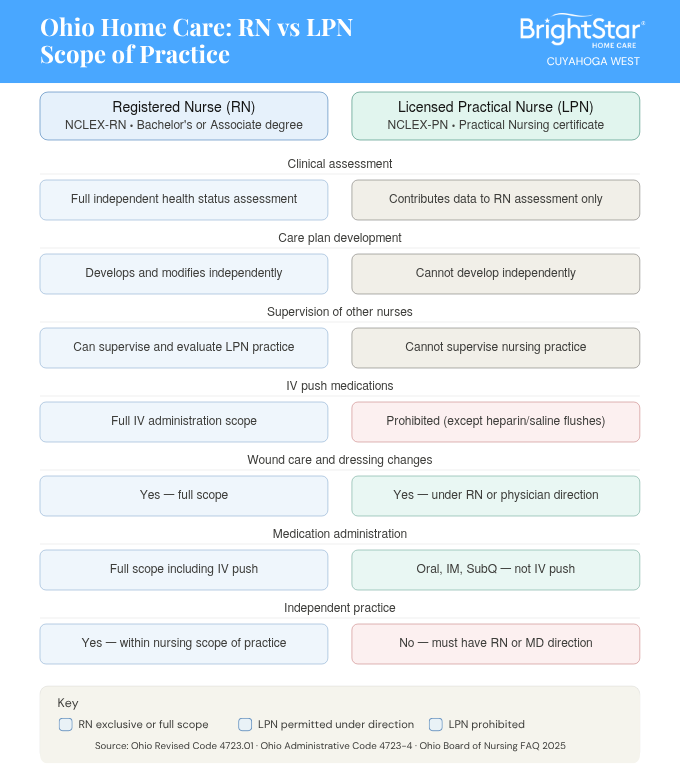
This is the question families rarely ask and agencies rarely explain clearly. The difference between a Registered Nurse and a Licensed Practical Nurse is not primarily about experience. It is about legally defined scope of practice under the Ohio Nurse Practice Act (Ohio Revised Code Section 4723.01).
What a Registered Nurse Can Do
Under Ohio Revised Code Section 4723.01(B), an RN's scope of practice in Ohio includes:
- Full clinical assessment of a patient's health status for the purpose of providing nursing care
- Developing and modifying care plans based on clinical findings
- Supervising and evaluating the nursing practice of LPNs and other nursing staff
- Teaching nursing practice to other licensed nurses
- Independent clinical decision-making within the nursing scope
- All skills performed by LPNs
In the home care context, this means an RN is the appropriate clinician to conduct intake assessments, build care plans, make independent clinical determinations, and oversee any LPN who is delivering care to the same client. When something in a client's condition changes, the RN evaluates what it means and decides what to do about it.
What a Licensed Practical Nurse Can Do
Under Ohio Revised Code Section 4723.01(F), an LPN in Ohio provides nursing care requiring application of basic knowledge of biological, behavioral, social, and nursing sciences, but always at the direction of an RN, physician, or other authorized health care provider. In the home care setting, an LPN working under RN supervision can perform:
- Vital signs monitoring and documentation
- Wound assessment and dressing changes
- Medication administration (oral, intramuscular, subcutaneous)
- Catheter care
- Specimen collection
- Observation and documentation of patient status
- Reporting changes to the directing RN
What an LPN cannot do independently under Ohio law:
- Assess health status for purposes of providing nursing care (that requires an RN)
- Administer IV push medications, other than heparin or saline flushes (Ohio Administrative Code Rule 4723-4-08)
- Supervise or evaluate the nursing practice of other nurses
- Develop or modify a nursing care plan independently
- Practice nursing without RN or authorized provider direction
This matters for families choosing a home care provider. An agency that deploys LPNs without active RN oversight is not operating within Ohio's framework for safe nursing practice. The structure matters as much as the credential.
Side-by-Side Comparison
| Registered Nurse (RN) | Licensed Practical Nurse (LPN) | |
|---|---|---|
| Education | Associate or Bachelor's degree in nursing + NCLEX-RN | Practical Nursing certificate + NCLEX-PN |
| Ohio legal authority | Full independent nursing scope | Directed practice under RN or physician |
| Clinical assessment | Can independently assess health status | Contributes data to RN's assessment |
| Care plan development | Can develop and modify independently | Cannot develop independently |
| IV push medications | Yes | No (except heparin/saline flushes) |
| Supervision of others | Can supervise LPNs and nursing staff | Cannot supervise nursing practice |
| Wound care | Yes | Yes (under direction) |
| Medication administration | Full scope | Oral, IM, SubQ, not IV push |
At BrightStar Care of Cuyahoga West, both RNs and LPNs are part of our clinical team. Every care plan is built by our Director of Nursing and every client, regardless of which nurse conducts the visit, is under active RN clinical oversight. That oversight is not a formality. Our Director of Nursing reviews every visit note from every nurse on every client.
When Does Someone Need In-Home Nursing Care?
Not every situation that requires more support calls for skilled nursing. Understanding the line between personal care needs and clinical nursing needs helps families make the right call without over- or underreacting.
Skilled nursing is clearly indicated when:
- A physician has ordered skilled nursing services following a hospital discharge or diagnosis
- A wound requires clinical assessment and proper dressing technique beyond basic first aid
- A chronic condition (CHF, COPD, diabetes, kidney disease) is actively being monitored and managed
- The patient is receiving IV therapy, injections, or infusion medications at home
- Post-surgical recovery requires incision monitoring or drain management
- A clinical assessment is needed to establish or update a care plan
- Medication complexity (multiple prescribers, high-risk drugs, injections) requires nursing review
- Cognitive decline has reached a point where clinical monitoring of behavioral and safety status is needed
Personal care or companion care is more appropriate when:
- The primary needs are bathing, dressing, meal preparation, and household tasks
- There are no active clinical conditions requiring monitoring or treatment
- The main concern is safety, companionship, or family caregiver support
Many clients receive both: personal care for daily living support and skilled nursing for clinical oversight, under the same care plan and through the same agency, and that coordination is one of the practical advantages of working with a full-service provider. For a fuller picture of when nursing care becomes necessary, our guide on when the elderly need nursing care at home walks through the key signals in detail.
What In-Home Nursing Costs in Greater Cleveland in 2026
Skilled nursing in the home is billed differently from personal care, and the cost reflects the clinical training and licensure involved.
At BrightStar Care of Cuyahoga West, skilled nursing services are billed at $65 to $90 per hour, depending on the nature and complexity of the services provided.
For context, here is how that compares to national and regional benchmarks:
| Care Type | National Median (2025 CareScout Survey) | BSC Cuyahoga West |
|---|---|---|
| Non-medical home caregiver | $35/hr | $32–$42/hr (companion/personal care) |
| Private duty skilled nursing | $90/hr (median) | $65–$90/hr |
| Per-visit skilled nursing | $160/visit (CareScout 2025 press release median) | Varies by visit type |
Sources: CareScout 2025 Cost of Care Survey (formerly Genworth); BrightStar Care of Cuyahoga West current rates.
Most families do not require skilled nursing visits every day or for extended hours. A visit schedule of two to four times per week for wound care, medication management, or chronic disease monitoring is common and keeps costs manageable. At $65 to $90 per hour and an average visit of one to two hours, a twice-weekly skilled nursing schedule runs approximately $520 to $1,440 per month, depending on visit length and complexity.
How In-Home Nursing Is Paid For
Skilled nursing in the home can be covered through several payment pathways, depending on the clinical situation and the patient's eligibility.
Medicare
Medicare covers skilled nursing care at home for qualifying patients who are homebound, have a physician's order for skilled nursing, and receive care from a Medicare-certified agency. Coverage is for medically necessary, intermittent skilled care, not long-term custodial support. When these criteria are met, Medicare covers the cost with no coinsurance for home health services after the Part B deductible. Coverage typically follows a hospital discharge or a qualifying clinical event.
BrightStar Care of Cuyahoga West does not accept Medicare for custodial home care. For Medicare-covered skilled episodes, families should confirm the agency's Medicare certification status before beginning care.
Long-Term Care Insurance
Most long-term care insurance policies cover skilled nursing at home once the benefit trigger is met, typically the inability to perform two or more activities of daily living or a cognitive impairment requiring supervision. Policy terms vary. Families should confirm whether the policy requires care to be provided by a licensed agency, what the daily or monthly benefit limit is, and what the elimination period means for out-of-pocket costs before care begins.
VA Benefits
Veterans and surviving spouses may qualify for VA Aid and Attendance benefits, which provide tax-free monthly payments of up to $2,874 for eligible wartime veterans with one dependent in 2026. These payments can be applied to skilled nursing costs and are not restricted to VA-approved providers. The Cuyahoga County Veterans Service Commission (216-698-2600) assists veterans with benefit applications at no cost.
HSA and FSA
Skilled nursing care at home qualifies as a medical expense under IRS Publication 502, making it reimbursable from Health Savings Accounts and healthcare Flexible Spending Accounts when the care is medically necessary. Our HSA and FSA guide for home care explains the documentation requirements and which services qualify.
Private Pay
Private pay remains the most flexible option, allowing families to select their provider, schedule, and care structure without navigating insurance criteria or benefit programs. For families comparing private pay costs against facility-based care, our Cleveland home care vs. assisted living guide has the full breakdown.
What to Look for in a Cleveland Home Nursing Provider
Not all home care agencies offering skilled nursing operate at the same clinical standard. Here is what to evaluate before making a decision.
Clinical oversight structure. Who builds the care plan, and are they a Registered Nurse? Who reviews visit documentation, and how often? These are not administrative questions. They are patient safety questions. An agency whose care plans are created by a coordinator rather than an RN, or whose clinical notes are filed without review, is operating with a meaningful gap in oversight.
Ohio licensure. Home health agencies in Ohio are licensed by the Ohio Department of Health. Verify that any agency you are considering is currently licensed and in good standing at health.ohio.gov.
Employee status. Ask whether nurses are W2 employees or independent contractors. W2 employment means the agency carries liability insurance and workers' compensation. Independent contractor arrangements shift that exposure to the hiring family.
Continuity of assigned nurse. For ongoing clinical conditions, consistency of the assigned nurse is not a scheduling convenience. It is a clinical advantage. A nurse who sees the same patient over time develops the longitudinal knowledge that allows early detection of deterioration. Ask about the agency's policy on caregiver consistency.
Communication with the treating physician. Clinical hand-offs between the home care nurse and the prescribing physician are important and often weak in agencies that do not have clear protocols for them. Ask how and how quickly the agency communicates concerns to the treating physician.
At BrightStar Care of Cuyahoga West, our clinical team includes Registered Nurses and Licensed Practical Nurses who are W2 employees working from care plans built and actively overseen by our Director of Nursing. We serve families throughout Middleburg Heights and the greater Cleveland area with skilled nursing services across the full range of clinical needs.
Frequently Asked Questions
Does Medicare cover in-home nursing care in Cleveland?
Medicare covers skilled nursing care at home for qualifying patients who are homebound and have a physician's order for services, delivered by a Medicare-certified agency. Coverage is for intermittent skilled care following a qualifying medical event, not for long-term ongoing nursing support. BrightStar Care of Cuyahoga West does not accept Medicare for custodial care.
What is the difference between a home health aide and a skilled nurse?
A home health aide or personal care aide provides non-medical support: bathing, dressing, meal preparation, companionship, and household assistance. A skilled nurse, whether an RN or an LPN, provides clinical care: medication administration, wound care, IV therapy, vital sign monitoring, and health assessment. Both can be part of the same care plan.
Can an LPN work independently in my loved one's home?
Under Ohio law, an LPN must practice under the direction of an RN, physician, or other authorized health care provider. In a well-structured home care agency, an LPN conducts visits under the clinical oversight of an RN who has built the care plan and actively monitors visit documentation. An LPN working without that oversight is not within Ohio's legal framework for nursing practice.
How many times per week does a skilled nurse typically visit?
Visit frequency depends entirely on the clinical need. Some conditions require daily visits; others are effectively managed with two or three visits per week. A client receiving IV antibiotics may need daily nursing visits for the duration of the course. A client with stable chronic disease management may need weekly monitoring. The care plan should drive the schedule, not a default template.
What happens if my loved one's condition changes between nursing visits?
At BrightStar Care of Cuyahoga West, our Director of Nursing reviews every visit note and is available to respond to changes in condition outside of scheduled visits. If a nurse documents a concern that requires action before the next scheduled visit, our clinical team follows up. Families can also reach us directly at (216) 483-8936 at any time.
Is in-home nursing covered by private health insurance?
Standard private health insurance generally does not cover long-term in-home nursing care. Some plans cover medically necessary skilled nursing for acute conditions, but ongoing care for chronic conditions or general monitoring is typically not covered. Long-term care insurance, VA benefits, HSA/FSA funds, and private pay are the primary pathways for most families.
To schedule a free in-home clinical assessment or to speak with our Director of Nursing about skilled nursing services in Middleburg Heights and the greater Cleveland area, contact BrightStar Care of Cuyahoga West at (216) 483-8936.