
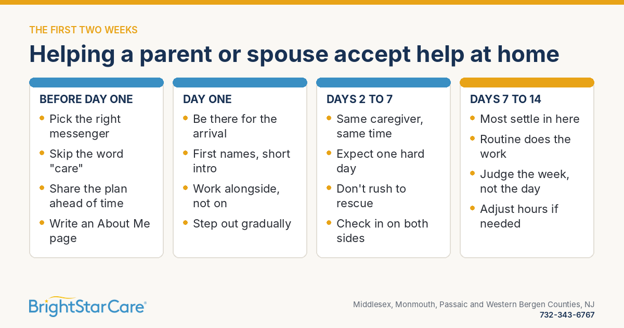
The start date is Monday morning at nine. Your father has told you twice he will not open the door, and your mother keeps saying they have managed for fifty years and will keep managing. You have a caregiver name, a schedule, and a knot in your stomach. The care is a necessity, but that is only half of the challenge.
Here is the most useful thing we can tell you. Helping a loved one accept home care is rarely one conversation. It usually takes one to two weeks, and what a family does before the first visit, on the first day, and over the days after matters more than whatever argument got everyone here.
This guide is for adult children and for husbands and wives trying to bring help into the house without damaging the relationship or having an outright refusal to accept care. For the background on why older adults push back, see our May post, “Why Seniors Resist Home Care”. This one is about what to do next.
How long does it usually take a resistant parent to accept a caregiver?
For most families, the hardest stretch is the first one to two weeks, and acceptance climbs quickly after that.
We saw this in our own numbers. In an internal review of 78 of our clients, covering roughly 2024 through 2026, every one had told us at least twice during intake that they did not want help or did not want someone in the house. Most settled in with their caregiver within 7 to 14 days. Three never accepted care and stopped services.
We include those three because they are real, and because the rest of the number means more when nobody is left out.
The households where client acceptance came faster had a few things in common:
- The same one or two caregivers, not a rotation of new faces.
- Enough hours in the week for a real relationship to form.
- A family that stayed calm and stayed involved.
- Help presented as protecting independence, not taking it away.
What should you do before the caregiver's first day?
Most of the work happens before day one.
Who should bring up the need, and when?
- Who: the person they are least likely to argue with. A doctor, a sibling, a pastor, or an old friend may get further than the closest child.
- When: a calm, rested hour. Not right after a fall, a fight, or a hard doctor's visit. Perhaps over a shared meal. For someone with memory changes, mornings are usually better.
- How often: expect more than one conversation. A first no is not a final answer.
What words should you use, and which should you avoid?
Drop "care," "caregiver," "aide," and "you need." To many seniors those words mean decline and losing control, and the conversation ends before it starts. Use everyday language and name the specific task.
| Instead of | Try |
|---|---|
| "You need care." | "I found someone to help with a few things around the house, so you have more time and energy for the things you enjoy?" |
| "We're getting you a caregiver." | "Maria is coming Tuesday to help with groceries, lunch, and anything else you would like." |
| "You can't be alone anymore." | "I'd feel better knowing someone is around in the afternoons." |
| "You need help showering." | "Someone can give you a hand getting ready, so you're not rushing." |
| "It's not safe for you." | "A little extra help could make it easier for you to keep doing the things you enjoy and stay independent at home." |
- Make it about you when that is true. "This would help me" is much harder to refuse than "this is for you."
- Tie it to what they want to keep doing, like church, the garden, or the Thursday card game.
- Use the person's name, not a job title. "Maria" is a person. "The aide" sounds like something has gone wrong.
What else should be in place before day one?
- Start with a task they would welcome. Groceries, lunch, a ride to the hairdresser. Lead with what feels like a favor, not supervision.
- Let the doctor say it. Many parents who brush off their children will listen to their physician. Call ahead and ask whether the doctor would bring it up.
- Give real choices. Morning or afternoon, Tuesday or Wednesday, which job comes first. People go along with what they helped decide.
- Share the plan ahead of time. The caregiver's first name, the day, the time, and what she will help with. A knock at the door should never be a surprise.
- Write a one-page "About Me." Preferred name, routines, favorite foods, the stories they love to tell, what upsets them, what calms them. It turns a stranger into someone who already knows your father takes his coffee black and still talks about the 1986 Giants.
- Tell the truth. Bringing someone in as "a friend from church" may get the door open on Monday, but when the story falls apart you lose trust you will need for the next two weeks.
- Agree as a family first. If one sibling says this is temporary and another says it is permanent, your parent will find the crack.
What should happen on the first day of home care?
The first day has one job: to end with your loved one willing to see this person again.
- Be there for the arrival and the first hour. Your presence tells your parent this person is safe.
- Keep the introduction short. "Dad, this is Maria. She's going to give us a hand on Tuesdays and Thursdays." Then stop. A long explanation sounds like a sales pitch.
- Visit before working. Coffee, a walk around the yard, the pictures on the refrigerator.
- Have the caregiver work alongside, not on. Making lunch together feels very different from being taken care of.
- Step out gradually. Another room, then a short errand, then longer. Say when you will be back, and come back on time.
- Hold the most personal tasks if they can safely wait. A shower on day one is a lot to ask of someone who met this person an hour ago.
- Do not debate it in front of the caregiver. If your mother says she does not need any of this, "I know. It's helping me a lot" is enough.
- End on a good note. Later, mention something kind the caregiver said. People remember how the day ended.
Avoid "She's here to watch you," "You have to let her help," and "It's only temporary" unless it really is.
What should you expect over the first few days, and what helps?
Expect pushback in the first week, including at least one day that feels like it is going backward. That is part of the process, not a sign it failed.
- Day two can be harder than day one. The novelty wears off. Do not read too much into it.
- Keep the same caregiver and the same time slot. Routine does a lot of the persuading for you.
- Build in enough time together. Start small with the task, not the schedule. Two hours twice a week is barely enough to learn each other's habits, and longer, more frequent visits usually help a relationship form faster.
- Do not rush in to rescue. If your mother complains the towels were folded wrong, listen, sympathize, and do not cancel. Small friction is how two people find a rhythm.
- Check in privately with both sides. Ask your parent what they liked, not whether they like it. Ask the caregiver where your parent pushes back, and share that with the agency.
- Know adjustment from a real problem. Grumbling and "I don't need her" are adjustment. A safety concern, a clash that keeps getting worse, or a parent who seems frightened deserves a call to the agency right away.
What is different when the person resisting is your spouse?
When a husband or wife says no, the resistance is usually less about the help and more about what it seems to say about the marriage. A spouse who has been doing the caregiving often sees that job as theirs, and bringing someone in can feel like failure or like a stranger coming between them. Sometimes the spouse who needs help is fine with it, and the caregiving spouse is the one who digs in.
- Present it as support for the caregiving spouse. "This gives you your Tuesday mornings back" lands better than "Dad needs more than you can do."
- Leave them in charge of what matters most to them. If your mother wants to keep making his breakfast, the caregiver can take the laundry and the shower.
- Start with what wears them down most, usually bathing, nights, or errands.
- Be honest about their health. A spouse who is exhausted or hurting their back lifting a partner is a second person at risk. Encourage them to see their own doctor.
- Let the spouse welcome the caregiver on day one, not the adult children. It keeps the house theirs.
How do you introduce a caregiver to someone with dementia?
With dementia, the goal shifts from persuading to making the caregiver familiar. Explanations do not hold the way they used to, but faces, routines, and feelings still do.
- Be in the room for the first several visits. Stay close, then step out a little longer each time, until your loved one seems comfortable alone with the caregiver.
- Pick their best time of day. For many people with Alzheimer's disease, late afternoon and early evening are harder, according to the National Institute on Aging. Mornings are usually better for the first visits.
- Keep explanations short, true, and the same each time. "This is Maria. She's here to help me out today."
- Skip yes or no questions about help. "Do you want help with your shower?" will usually get a no. "Maria is going to start the water for you" tends to go better.
- Respond to the feeling, not the facts. If your mother says she does not know this woman, correcting her rarely helps. "You don't know her yet, and that feels strange. I'm right here." The Alzheimer's Association advises against criticizing or correcting and suggests paying attention to the feelings behind the words.
- Post a photo. A picture of the caregiver with her first name, on the refrigerator and by the front door.
- Keep the same person. With dementia, a rotating schedule can mean meeting a stranger at every visit.
- Plan for the door. Your loved one may not recognize the caregiver at first and may not let her in. Have a family member there, or on the phone, for the first several arrivals.
When is easing in no longer the right approach?
Easing in works when there is time. It does not work when your loved one is not safe alone during the hours no one is there. That usually looks like:
- Repeated falls, or trouble getting up after one.
- Getting up at night confused.
- Medications missed or taken twice.
- A recent hospital or rehab discharge.
- A spouse who can no longer manage the lifting.
- Wandering, or leaving the stove on.
A few hours a week leaves the riskiest times uncovered, which for most families are mornings, bathing, and overnight. That is where longer shifts, live-in care, or 24- hour care fit, and our July post, “Live-In vs. 24-Hour Home Care in New Jersey”, explains the difference. And in our experience, live-in arrangements often bond quickly, because the same person is there for every meal and every hard moment. A resistant parent with one familiar face in the house often adjusts faster than one who sees a different person three times a week.
How can Brightstar Care help a resistant loved one accept care?
We have been through this many times and will act as a partner, not just a scheduler. Ask any agency how they handle a client who does not want help, and listen for specifics. At BrightStar Care, that looks like this:
- A Registered Nurse oversees every case and writes the plan of care around your loved one's habits and preferences, not only their needs. We always try to have that same nurse in the home on day one of care, and then at least every 2 months thereafter (more frequently if necessary).
- We try to keep new cases with one or two caregivers whenever possible, because consistency is what we see speed things up.
- We present help as a way to stay independent at home, and we coach families to do the same.
- A live team member who knows your case is reachable 24 hours a day, so a rough first evening does not have to wait until Monday.
Questions families ask about resistance in the first week
What if my mother fires the caregiver on the first day?
Do not cancel the next visit on the spot. A first-day "I don't want her back" is common and often fades within a few days. Talk with the agency, adjust what you can, and try again. If the match is truly wrong after a fair try, ask for someone else.
Should I stay in the house on the first day?
Yes, for at least the first part of it. When you are in the room, the caregiver feels safe by association. Then step out gradually.
My father will not let the caregiver help him shower. What now?
Set the shower aside for a few days if it can safely wait, and let trust build around easier tasks. When you come back to it, have the caregiver set things up and stay close rather than take over, and protect his privacy. If hygiene is turning into a health concern, talk with his doctor.
Is it okay to call the caregiver a friend?
For most people, no, because it backfires when the truth comes out. Her first name, or "someone who helps me out," is honest and easier to accept. For someone with moderate or advanced dementia, a short, gentle explanation is kinder than a detailed one.
Is it normal to feel guilty about bringing in help?
Very. Many adult children feel they are letting a parent down, and many spouses feel they should be able to do it all. Bringing in help is often what lets you go back to being a son, daughter, husband, or wife instead of a full-time caregiver.
Who can help you plan the first two weeks?
November is National Family Caregivers Month, and Thanksgiving is often when families see up close what has been changing all year. If a conversation about help is coming at your house, you do not have to plan it alone.
BrightStar Care of Greater Middlesex, Monmouth, Passaic and Western Bergen Counties is a family owned, Joint Commission accredited home care agency serving those New Jersey counties, with RN-led in-home care 24 hours a day, 7 days a week. Our free in-home care assessment is a good time to talk through how to introduce help at your house, including what to say and what to avoid. Call 732-343-6767.
This article is general information, not medical advice. If your loved one's memory, mood, or behavior is changing, talk with their doctor.