
.png "1-(1).png")
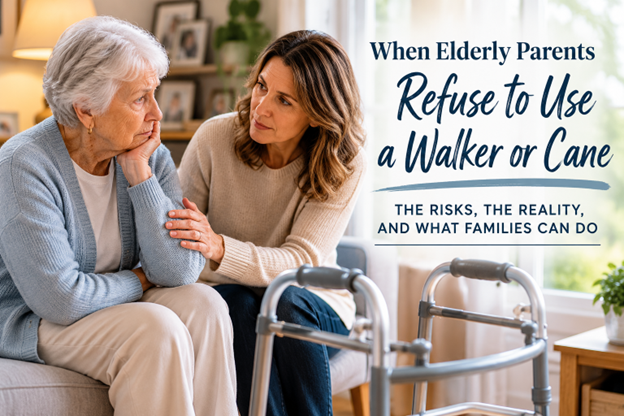
One of the most common — and emotionally exhausting — situations families face in elder care is when aging parents refuse to use a walker or cane despite repeated falls.
As a home care provider, we see this constantly.
A 90-year-old falls, ends up hospitalized, returns home, and still refuses the walker sitting right next to them. Families are left terrified, frustrated, and emotionally drained trying to prevent the next emergency.
The challenge is that this usually is not about logic.
It is about identity, independence, pride, fear, and aging.
Why Seniors Refuse Walkers and Canes
Many older adults view mobility aids as symbols of decline, weakness, dependence, or loss of control.
This is especially true among generations that valued toughness, self-reliance, and “pushing through” physical limitations without complaining.
So when adult children say things like:
- “You’re not safe walking alone.”
- “You need to use your walker.”
- “You’re going to fall again.”
…the conversation often creates resistance instead of cooperation.
The senior hears:
“You’re becoming helpless.”
That emotional reaction is powerful.
The Reality of Falls in Older Adults
Falls in elderly adults are not minor events.
A serious fall at age 90 or 91 can permanently change:
- mobility
- cognition
- independence
- quality of life
- long-term health outcomes
We regularly see seniors go from living independently to requiring full-time care after:
- hip fractures
- head injuries
- prolonged hospitalizations
- rehabilitation setbacks
- loss of confidence walking
Many older adults never fully recover physically or emotionally after a major fall.
That is why fall prevention for seniors is one of the most important parts of aging safely at home.
A Better Way to Talk About Walkers and Canes
One of the biggest mistakes families make is framing mobility aids as a loss.
Examples:
- “You can’t walk safely anymore.”
- “You’re too unstable.”
- “You have no choice.”
This approach often increases resistance.
Instead, try reframing the walker or cane as a tool for maintaining independence.
Examples that often work better:
- “This helps you stay in your home longer.”
- “This keeps you OUT of the hospital.”
- “This helps you stay active.”
- “This gives you more control.”
- “This helps you conserve energy.”
The goal is shifting the conversation from weakness to independence.
Why Seniors Listen to Professionals More Than Family
Another important reality in elder care:
Older parents often respond better to recommendations from professionals or peers than from their own children.
Families frequently tell us:
“I’ve been saying this for months and suddenly they listen to the physical therapist.”
That is extremely common.
Sometimes recommendations carry more weight when they come from:
- physicians
- physical therapists
- occupational therapists
- caregivers
- friends
- other seniors
If family conversations are becoming emotionally charged, involving outside professionals can help reduce conflict.
Home Safety Tips for Seniors at Risk of Falling
If an elderly parent refuses to use a walker or cane consistently, families should focus on reducing other fall risks inside the home.
Some important fall prevention strategies include:
Remove Tripping Hazards
- loose rugs
- electrical cords
- cluttered walkways
- unstable furniture
Improve Lighting
Poor lighting dramatically increases fall risk, especially at night.
Consider:
- brighter hallway lighting
- motion-sensor night lights
- illuminated bathroom paths
Install Safety Equipment
Helpful additions may include:
- grab bars
- shower chairs
- stair railings
- raised toilet seats
- non-slip mats
Encourage Strength and Balance Work
Physical therapy and strength exercises can improve:
- balance
- mobility
- confidence
- endurance
Review Medications
Some medications increase:
- dizziness
- fatigue
- confusion
- low blood pressure
- fall risk
Medication reviews with physicians are extremely important for older adults with recurrent falls.
The Emotional Toll on Adult Children
This is the part many people do not talk about enough.
Adult children often become trapped in a constant state of hypervigilance:
- waiting for the next phone call
- worrying about another hospitalization
- feeling responsible for preventing every fall
- carrying guilt no matter what happens
It is exhausting.
And families need to hear something difficult but important:
You cannot care more about another competent adult’s safety than they do forever.
You can encourage.
You can educate.
You can reduce risks.
You can support safer choices.
But mentally competent adults still retain the right to make decisions we strongly disagree with.
That is one of the hardest realities families face in elder care.
Final Thoughts on Elderly Fall Prevention and Independence
There is rarely a perfect solution when aging parents refuse help.
Sometimes compromise works better than ultimatums:
- cane indoors
- walker outdoors
- walker at night
- walker only when fatigued
Start somewhere.
The goal is not perfection.
The goal is reducing risk while preserving dignity, independence, and quality of life for as long as possible.
For many families, that balancing act is one of the hardest parts of caregiving.