
One of the hardest things about an Alzheimer's diagnosis is that it does not end the uncertainty it opens into it. Families who have just learned that a parent or spouse has Alzheimer's disease often find themselves asking the same questions in different forms: What comes next? How long do we have before things change? What will we need to do that we are not doing now?
There are no perfect answers. Alzheimer's is a disease that moves at its own pace, on its own timeline, in ways that are shaped by the individual; their age at diagnosis, their overall health, the particular pattern of the disease in their brain. But there is a framework that helps. Understanding the broad stages of Alzheimer's progression, what typically happens in each, what care needs emerge, and how families can prepare, turns an overwhelming unknown into something that can be planned for, one stage at a time.
This guide is written for families in Scottsdale, Paradise Valley, Fountain Hills, Cave Creek, and across the greater Scottsdale area who are navigating this journey and want to understand what lies ahead with clarity and honesty.
Several staging systems exist for Alzheimer's disease. The most widely used by clinicians is the Global Deterioration Scale (GDS), which describes seven stages. A simpler and often more practical framework for families describes three broad phases: early, middle, and late stage. This guide uses the three-stage framework because it maps most naturally to the care decisions families face — while acknowledging that the boundaries between stages are gradual, not sudden, and that every person's experience is unique.

In early stage Alzheimer's, the person is typically still fully capable of managing most daily activities independently. They may be aware of their own cognitive changes, which frequently causes significant anxiety and depression. They can usually drive, manage their finances with some oversight, participate in social activities, and contribute meaningfully to conversations about their own care. This awareness and capability make early stage a critically important window for planning.
The changes in early stage are most visible in complex tasks that require sequential thinking and working memory — managing finances, following multi-step recipes, keeping track of medications, navigating new or unfamiliar situations. Appointments may be missed. Bills may go unpaid. Errors in judgment leaving the stove on, taking a wrong turn on a familiar route begin to appear.
Early stage is the time to have conversations that become much harder later. While your loved one can still fully participate in decisions about their own life, engage them in discussions about their wishes for future care, legal and financial planning (power of attorney, advance directives), and what living at home will look like as needs evolve.
This is also the right time to begin exploring in-home support not because it is urgently needed yet, but because introducing a caregiver when the person with Alzheimer's is still socially capable and cognitively aware makes the adjustment far easier than waiting until a crisis demands it. A caregiver who becomes familiar and trusted in early stage is a tremendous asset in the stages that follow.
What BrightStar Care can provide in early stage: Companion care and light personal support, medication reminders, transportation to medical appointments and social activities, and gentle household assistance structured around maintaining the person's independence and routine as fully as possible.
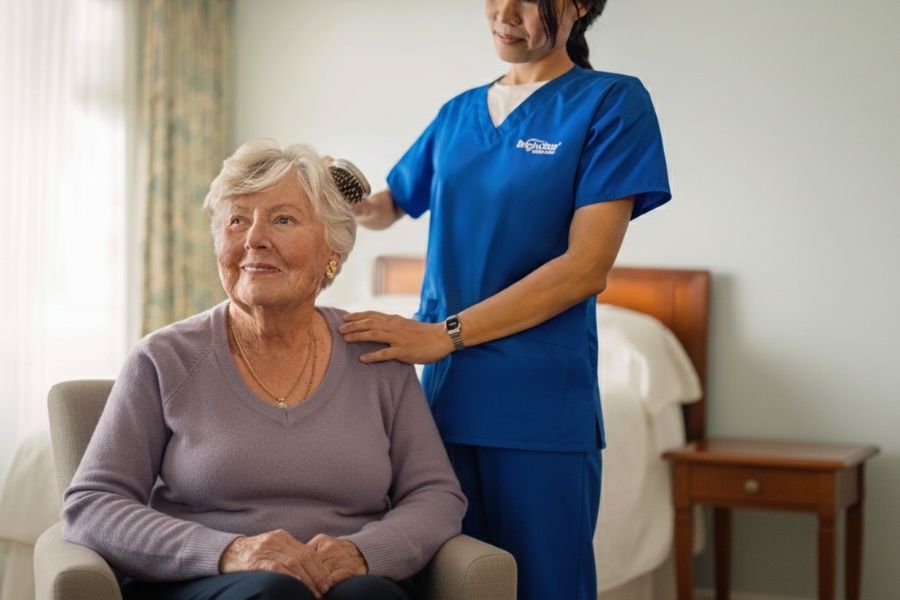
The person with Alzheimer's is increasingly dependent on others for daily activities. They may no longer be able to safely drive, manage their finances, cook without supervision, or be left alone for extended periods. They may resist help with personal care, insist that they can do things they can no longer safely do, or become frightened and upset in situations that did not previously cause distress.
Middle stage is when the home environment itself becomes a clinical consideration. Wandering is a serious safety risk — door alarms, GPS devices, and physical modifications become important safeguards. The kitchen, bathroom, and stairways all require attention. Nighttime confusion and sleep disruption are common, sometimes severely affecting the caregiver's own sleep and functioning.
Personal care bathing, dressing, toileting becomes a daily challenge. The person may resist assistance or become agitated during care routines. Established caregivers who know the person's preferences, triggers, and routines navigate these moments far more effectively than unfamiliar faces.
Behavioral symptoms, what clinicians call behavioral and psychological symptoms of dementia (BPSD) peak in the middle stage for many patients. Sundowning, the increase in confusion and agitation that typically occurs in the late afternoon and early evening, is particularly common and particularly difficult to manage without experienced support.
Nutrition and hydration also become concerns. Forgetting to eat, losing interest in food, or forgetting that a meal has already been eaten can all contribute to nutritional decline. Weight loss is a common and clinically significant finding in middle stage Alzheimer's patients.
Middle stage is when most families discover that managing Alzheimer's care at home is a full-time job one that frequently exceeds what any single family member can sustain without support. Caregiver burnout is not a personal failure. It is an almost inevitable consequence of trying to provide around-the-clock supervision and care for a person with increasing and complex needs without professional assistance.
This is the stage where structured, regular in-home care becomes not just helpful but essential. For many families in the greater Scottsdale area, this is also the stage where the question of how to fund care becomes urgent which is why planning for long-term care insurance, VA benefits, and private pay earlier in the journey matters so much.
For families caring for a loved one during Arizona's extreme summer months, middle stage Alzheimer's carries additional risk. Heat sensitivity increases with cognitive decline, and a person with Alzheimer's may not accurately perceive or communicate that they are overheated or dehydrated. Outdoor time requires careful management, and indoor temperature control is a genuine clinical priority from June through September.
What BrightStar Care can provide in the middle stage: Structured daily caregiving including personal care assistance, safe mobility and fall prevention, meal preparation and nutrition monitoring, medication reminders, companionship and behavioral support, transportation, and household management. For patients with clinical needs, skilled wound care, medication administration, condition monitoring, our registered nurses and LPNs provide integrated skilled nursing alongside caregiver support. For families navigating the emotional toll of the middle stage, our consistent caregiver presence also provides meaningful respite.
Late stage is also when physical complications become most serious. Immobility creates risk for pressure injuries and blood clots. Swallowing difficulties (dysphagia) increase the risk of aspiration pneumonia — one of the leading causes of death in late stage Alzheimer's. Infections and illness are harder to detect because the person can no longer communicate symptoms. The immune system weakens alongside the rest of the body.
This is a phase defined not by what can be done to alter the course of the disease — it cannot be altered but by what can be done to ensure the person is comfortable, dignified, and not alone.
Late stage care is essentially full-time nursing and personal care. The person requires assistance with all activities of daily living, repositioning to prevent pressure injuries, careful attention to nutrition and hydration often through modified texture diets or thickened liquids and skilled monitoring for the physical complications of immobility and advanced illness.
Many families choose to pursue hospice care in the late stage, which shifts the focus explicitly to comfort rather than curative treatment. Hospice provides important clinical oversight and emotional support but hospice visits are intermittent, typically a few times per week. The daily caregiving and skilled nursing between those visits remains the responsibility of the family and any in-home care agency involved in the patient's care.
BrightStar Care of Greater Scottsdale works alongside hospice providers as a complement to their services providing the around-the-clock or near-continuous caregiver presence and skilled nursing support that late stage care at home requires, while the hospice team manages the clinical and palliative coordination.
Late stage is not the time for major decisions, it is the time to be present. The decisions that matter most in this phase, whether to pursue hospitalization, what comfort measures to prioritize, who will be present, what the end-of-life environment will look like — are far easier to navigate when they were discussed and documented in early stage, when your loved one could still participate.
What families who are here without that advance planning need most is support: clinical support for the patient, emotional support for themselves, and the practical relief of knowing that their loved one is being cared for by people who are skilled, compassionate, and genuinely present.
What BrightStar Care can provide in late stage: Full personal care assistance, skilled nursing for wound care, medication management, condition monitoring, and hospice coordination; repositioning and skin integrity monitoring to prevent pressure injuries; nutrition and hydration support; and consistent compassionate presence through the most difficult chapter of this journey.
The families who navigate Alzheimer's with the most stability not ease, because this is never easy are the ones who plan ahead of each stage rather than reacting within it.
In early stage, that means legal and financial planning, honest conversations about care wishes, and introducing professional support before the need becomes urgent. In middle stage, it means building a care team that can grow with the patient's needs, securing funding for ongoing care, and ensuring that family caregivers are supported and not isolated. In late stage, it means leaning on the care team that has been built, honoring the wishes that were documented, and allowing yourself to be present rather than managing every detail alone.
At BrightStar Care of Greater Scottsdale, we work with families at every stage — from the first companion care visits in early stage through the complex skilled nursing and full personal care of late stage. We serve families throughout Scottsdale, Paradise Valley, Fountain Hills, Cave Creek, Carefree, and north Phoenix, and we are experienced in building care plans that evolve as the disease does.
Contact BrightStar Care of Greater Scottsdale Today:
BrightStar Care of Greater Scottsdale provides skilled nursing and non-medical home care services for individuals with Alzheimer's and dementia at every stage of the disease throughout Scottsdale, Paradise Valley, Fountain Hills, Cave Creek, Carefree, and north Phoenix. To speak with a care coordinator about your loved one's current stage and care needs, contact our Greater Scottsdale office today at 480-302-5139.
Call us Today Visit Our Website
There are no perfect answers. Alzheimer's is a disease that moves at its own pace, on its own timeline, in ways that are shaped by the individual; their age at diagnosis, their overall health, the particular pattern of the disease in their brain. But there is a framework that helps. Understanding the broad stages of Alzheimer's progression, what typically happens in each, what care needs emerge, and how families can prepare, turns an overwhelming unknown into something that can be planned for, one stage at a time.
This guide is written for families in Scottsdale, Paradise Valley, Fountain Hills, Cave Creek, and across the greater Scottsdale area who are navigating this journey and want to understand what lies ahead with clarity and honesty.
A Note on Staging Systems
Several staging systems exist for Alzheimer's disease. The most widely used by clinicians is the Global Deterioration Scale (GDS), which describes seven stages. A simpler and often more practical framework for families describes three broad phases: early, middle, and late stage. This guide uses the three-stage framework because it maps most naturally to the care decisions families face — while acknowledging that the boundaries between stages are gradual, not sudden, and that every person's experience is unique.
Early Stage Alzheimer's: When Life Still Looks Mostly the Same
What's Happening
Early stage Alzheimer's is often the most disorienting phase for families not because the symptoms are severe, but because they are subtle enough to be explained away. Forgetting a recent conversation. Losing track of dates. Struggling to find the right word. Misplacing things more often than before. These are the kinds of changes that can be attributed to stress, aging, or simply a bad week until they cannot be anymore.In early stage Alzheimer's, the person is typically still fully capable of managing most daily activities independently. They may be aware of their own cognitive changes, which frequently causes significant anxiety and depression. They can usually drive, manage their finances with some oversight, participate in social activities, and contribute meaningfully to conversations about their own care. This awareness and capability make early stage a critically important window for planning.
What Changes at Home
The changes in early stage are most visible in complex tasks that require sequential thinking and working memory — managing finances, following multi-step recipes, keeping track of medications, navigating new or unfamiliar situations. Appointments may be missed. Bills may go unpaid. Errors in judgment leaving the stove on, taking a wrong turn on a familiar route begin to appear.
What Families Should Do
Early stage is the time to have conversations that become much harder later. While your loved one can still fully participate in decisions about their own life, engage them in discussions about their wishes for future care, legal and financial planning (power of attorney, advance directives), and what living at home will look like as needs evolve.This is also the right time to begin exploring in-home support not because it is urgently needed yet, but because introducing a caregiver when the person with Alzheimer's is still socially capable and cognitively aware makes the adjustment far easier than waiting until a crisis demands it. A caregiver who becomes familiar and trusted in early stage is a tremendous asset in the stages that follow.
What BrightStar Care can provide in early stage: Companion care and light personal support, medication reminders, transportation to medical appointments and social activities, and gentle household assistance structured around maintaining the person's independence and routine as fully as possible.
Middle Stage Alzheimer's: The Longest and Most Demanding Phase
What's Happening
Middle stage Alzheimer's is typically the longest phase of the disease lasting years in many cases and it is where the caregiving demands become most intense. The changes that were subtle in early stage become significant. Memory loss deepens. Confusion about time, place, and sometimes the identity of familiar people becomes more frequent. Personality and behavior change in ways that can be startling and painful for family members agitation, suspicion, repetitive questioning, emotional volatility, and sometimes wandering.The person with Alzheimer's is increasingly dependent on others for daily activities. They may no longer be able to safely drive, manage their finances, cook without supervision, or be left alone for extended periods. They may resist help with personal care, insist that they can do things they can no longer safely do, or become frightened and upset in situations that did not previously cause distress.
What Changes at Home
Middle stage is when the home environment itself becomes a clinical consideration. Wandering is a serious safety risk — door alarms, GPS devices, and physical modifications become important safeguards. The kitchen, bathroom, and stairways all require attention. Nighttime confusion and sleep disruption are common, sometimes severely affecting the caregiver's own sleep and functioning.Personal care bathing, dressing, toileting becomes a daily challenge. The person may resist assistance or become agitated during care routines. Established caregivers who know the person's preferences, triggers, and routines navigate these moments far more effectively than unfamiliar faces.
Behavioral symptoms, what clinicians call behavioral and psychological symptoms of dementia (BPSD) peak in the middle stage for many patients. Sundowning, the increase in confusion and agitation that typically occurs in the late afternoon and early evening, is particularly common and particularly difficult to manage without experienced support.
Nutrition and hydration also become concerns. Forgetting to eat, losing interest in food, or forgetting that a meal has already been eaten can all contribute to nutritional decline. Weight loss is a common and clinically significant finding in middle stage Alzheimer's patients.
What Families Should Do
Middle stage is when most families discover that managing Alzheimer's care at home is a full-time job one that frequently exceeds what any single family member can sustain without support. Caregiver burnout is not a personal failure. It is an almost inevitable consequence of trying to provide around-the-clock supervision and care for a person with increasing and complex needs without professional assistance.This is the stage where structured, regular in-home care becomes not just helpful but essential. For many families in the greater Scottsdale area, this is also the stage where the question of how to fund care becomes urgent which is why planning for long-term care insurance, VA benefits, and private pay earlier in the journey matters so much.
For families caring for a loved one during Arizona's extreme summer months, middle stage Alzheimer's carries additional risk. Heat sensitivity increases with cognitive decline, and a person with Alzheimer's may not accurately perceive or communicate that they are overheated or dehydrated. Outdoor time requires careful management, and indoor temperature control is a genuine clinical priority from June through September.
What BrightStar Care can provide in the middle stage: Structured daily caregiving including personal care assistance, safe mobility and fall prevention, meal preparation and nutrition monitoring, medication reminders, companionship and behavioral support, transportation, and household management. For patients with clinical needs, skilled wound care, medication administration, condition monitoring, our registered nurses and LPNs provide integrated skilled nursing alongside caregiver support. For families navigating the emotional toll of the middle stage, our consistent caregiver presence also provides meaningful respite.

Late Stage Alzheimer's: Comfort, Dignity, and Presence
What's Happening
Late stage Alzheimer's is characterized by profound cognitive and physical decline. The ability to communicate verbally diminishes significantly words become scarce, and eventually communication shifts to nonverbal expression: facial expressions, sounds, touch. The person loses the ability to recognize family members, to walk independently, to swallow safely, and to manage any aspect of personal care without full assistance.Late stage is also when physical complications become most serious. Immobility creates risk for pressure injuries and blood clots. Swallowing difficulties (dysphagia) increase the risk of aspiration pneumonia — one of the leading causes of death in late stage Alzheimer's. Infections and illness are harder to detect because the person can no longer communicate symptoms. The immune system weakens alongside the rest of the body.
This is a phase defined not by what can be done to alter the course of the disease — it cannot be altered but by what can be done to ensure the person is comfortable, dignified, and not alone.
What Changes at Home
Late stage care is essentially full-time nursing and personal care. The person requires assistance with all activities of daily living, repositioning to prevent pressure injuries, careful attention to nutrition and hydration often through modified texture diets or thickened liquids and skilled monitoring for the physical complications of immobility and advanced illness.Many families choose to pursue hospice care in the late stage, which shifts the focus explicitly to comfort rather than curative treatment. Hospice provides important clinical oversight and emotional support but hospice visits are intermittent, typically a few times per week. The daily caregiving and skilled nursing between those visits remains the responsibility of the family and any in-home care agency involved in the patient's care.
BrightStar Care of Greater Scottsdale works alongside hospice providers as a complement to their services providing the around-the-clock or near-continuous caregiver presence and skilled nursing support that late stage care at home requires, while the hospice team manages the clinical and palliative coordination.
What Families Should Do
Late stage is not the time for major decisions, it is the time to be present. The decisions that matter most in this phase, whether to pursue hospitalization, what comfort measures to prioritize, who will be present, what the end-of-life environment will look like — are far easier to navigate when they were discussed and documented in early stage, when your loved one could still participate.What families who are here without that advance planning need most is support: clinical support for the patient, emotional support for themselves, and the practical relief of knowing that their loved one is being cared for by people who are skilled, compassionate, and genuinely present.
What BrightStar Care can provide in late stage: Full personal care assistance, skilled nursing for wound care, medication management, condition monitoring, and hospice coordination; repositioning and skin integrity monitoring to prevent pressure injuries; nutrition and hydration support; and consistent compassionate presence through the most difficult chapter of this journey.
Alzheimer's In-home Care Call us Today
Planning Ahead at Every Stage: The Most Important Thing Families Can Do
The families who navigate Alzheimer's with the most stability not ease, because this is never easy are the ones who plan ahead of each stage rather than reacting within it.In early stage, that means legal and financial planning, honest conversations about care wishes, and introducing professional support before the need becomes urgent. In middle stage, it means building a care team that can grow with the patient's needs, securing funding for ongoing care, and ensuring that family caregivers are supported and not isolated. In late stage, it means leaning on the care team that has been built, honoring the wishes that were documented, and allowing yourself to be present rather than managing every detail alone.
At BrightStar Care of Greater Scottsdale, we work with families at every stage — from the first companion care visits in early stage through the complex skilled nursing and full personal care of late stage. We serve families throughout Scottsdale, Paradise Valley, Fountain Hills, Cave Creek, Carefree, and north Phoenix, and we are experienced in building care plans that evolve as the disease does.
Contact BrightStar Care of Greater Scottsdale Today:
- Phone: 480-302-5139
- Address: 17015 N Scottsdale Rd, Ste 115, Scottsdale, AZ 85255
- Visit Us Online: BrightStar Care of Greater Scottsdale

Frequently Asked Questions
Q: What are the main stages of Alzheimer's disease and how long does each last?
Alzheimer's disease is generally described in three broad stages: early, middle, and late. Early stage when symptoms are subtle and the person remains largely independent can last two to four years or longer. Middle stage is typically the longest phase, often lasting several years, and is marked by significant memory loss, behavioral changes, and increasing dependence on others for daily care. Late stage involves profound cognitive and physical decline and full dependence on caregivers. Total disease duration from diagnosis varies widely, ranging from four to twenty years or more depending on age at diagnosis and overall health.Q: How do I know when it's time to get professional help for a family member with Alzheimer's?
Most families wait longer than they should. The right time to begin professional in-home support is earlier than feels necessary ideally in early stage, when the person with Alzheimer's can still build a relationship with a caregiver in a familiar, low-stress way. Practical signs that professional help is needed include: the family caregiver is exhausted or unable to keep up with daily demands; the person with Alzheimer's is being left alone for significant periods; personal hygiene, nutrition, or medication management is declining; behavioral symptoms like wandering or sundowning are occurring; or safety incidents such as falls or leaving the stove on have happened.Q: What kind of home care does someone with late stage Alzheimer's need?
Late stage Alzheimer's requires full personal care assistance bathing, dressing, toileting, feeding, and repositioning as well as skilled nursing for wound prevention and care, medication management, and monitoring of physical complications including aspiration risk, skin integrity, and infection. Many late stage patients are also enrolled in hospice, and in-home caregiving and skilled nursing can be provided alongside hospice services to ensure continuous, compassionate support between hospice visits. Care at this stage is intensive, around the clock, and requires both clinical expertise and deep human compassion.BrightStar Care of Greater Scottsdale provides skilled nursing and non-medical home care services for individuals with Alzheimer's and dementia at every stage of the disease throughout Scottsdale, Paradise Valley, Fountain Hills, Cave Creek, Carefree, and north Phoenix. To speak with a care coordinator about your loved one's current stage and care needs, contact our Greater Scottsdale office today at 480-302-5139.
Call us Today Visit Our Website