
The Architecture of Aging in the Valley
Whether your loved one resides in a charming mid-century ranch in Hudson, a historic multi-story home in River Falls, or a sprawling rural property in Somerset or New Richmond, the "bones" of a home often present hidden challenges as we age. What was once a beautiful architectural detail—like a narrow staircase, a sunken living room, or a high-threshold entryway—can quickly become a significant safety risk when mobility or cognitive challenges enter the picture.In Western Wisconsin, where winter ice and steep river-town geography add an extra layer of difficulty, "home safety" isn't just about clearing clutter. It’s about a proactive clinical strategy. At BrightStar Care of Hudson, our nurse-led home safety assessments are designed to identify the "red flags" that lead to hospital readmissions at Hudson Hospital & Clinic or other local medical centers.
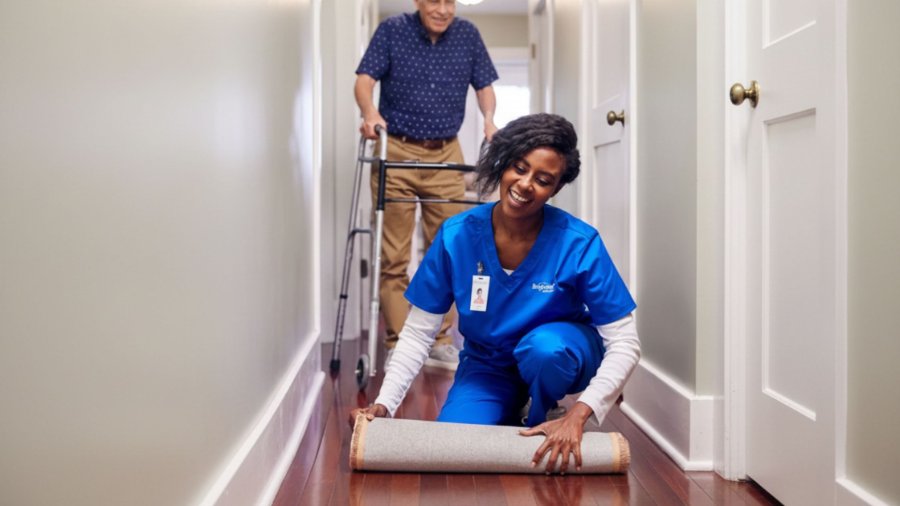
Safety Strategies for Mobility Challenges
Mobility issues, whether caused by Parkinson’s, arthritis, or post-surgical recovery, require a focus on "pathway physics."
- Clear the "High-Traffic" Zones: In older homes in River Falls or Roberts, hallways can be narrow. Ensure there is a clear, 36-inch wide path for walkers or wheelchairs. Remove all throw rugs—even the ones with "non-slip" backing—as they are the #1 cause of trips.
- Lighting the Way: Dim lighting is a major fall trigger. Install motion-sensor LEDs in bathrooms and hallways. In rural properties in Hammond or Baldwin, ensure exterior entryways are flooded with light to account for uneven gravel or pavement during those dark Wisconsin winters.
- The "Point of Entry" Fix: If a senior struggles with stairs, consider a ramp for the garage entry. Within the home, install high-contrast tape on the edge of steps to provide a visual cue for where the level changes.
Safety Strategies for Cognitive Challenges (Dementia & Alzheimer’s)
When memory loss is present, the home environment needs to be simplified to reduce "sensory overload" and prevent wandering.
- Environmental Cues: For a senior in the early stages of dementia, use high-contrast labels on drawers (e.g., "Socks," "Utensils"). In the kitchen, a "Stove Guard" or automatic shut-off device is a critical clinical safety feature.
- Wandering Prevention: If your loved one is prone to "elopement," install door alarms that alert you when a perimeter is crossed. Placing a black rug in front of the exit can sometimes act as a "visual barrier" that seniors with cognitive decline may perceive as a hole, discouraging them from crossing.
- Reducing Reflections: Large mirrors can be confusing for those with advanced memory loss, as they may not recognize their own reflection. Simply covering or removing mirrors in high-stress areas like bathrooms can significantly reduce late-day agitation or "sundowning."
The "Nurse-Led" Difference: Beyond the Hardware
While grab bars and ramps are important, the most effective safety feature is a professional clinical eye.At BrightStar Care, our Registered Nurse (RN) Director of Nursing oversees every home safety plan. For a family in Hudson or New Richmond, this means:
- Medication Safety: We assess where medications are stored to prevent accidental double-dosing—a common risk for those with cognitive challenges.
- Gait & Balance Assessment: We don't just look at the floor; we look at how your loved one moves on it. We coordinate with local physical therapists to ensure the home supports their specific mobility needs.
- The "Unicorn Case" Oversight: If your loved one has both Parkinson’s and heart disease, our nurses ensure that their personal care routine accounts for both their "shuffling gait" and their energy levels.

Why Private Pay is the Choice for Immediate Safety
Families in Western Wisconsin often choose our private-pay model because safety cannot wait for "authorizations."
- Rapid Response: We can often conduct an RN assessment and have a caregiver in the home for companion or personal care within 24 to 48 hours.
- Flexible 24/7 Oversight: If a senior is at high risk for nighttime wandering, we provide 24/7 around-the-clock support to ensure they never face a "safety gap" while the family sleeps.
FAQs for Hudson area Families
1. Do I need to remodel my whole house?
Rarely. Most safety risks can be mitigated with simple, nurse-led adjustments like better lighting, furniture rearrangement, and the installation of professional-grade grab bars.2. Can you help me find local contractors for ramps?
Yes. We are deeply connected to the St. Croix County community and can often provide referrals to trusted local partners for home modifications in Hudson, River Falls, or Somerset.3. Does "Home Safety" include medication?
Absolutely. Medication management is a pillar of home safety. Our caregivers provide the reminders and oversight needed to prevent dangerous errors.
Take the Next Step with BrightStar Care of Hudson, WI
Don't wait for a fall to determine if your home is safe. Let our nurse-led team provide the "clinical edge" your family needs to stay safely in the home they love.Contact Us for a Free Assessment:
- Phone: 715-690-3900
- Address: 2200 Jack Berault Drive, Hudson, WI 54016
- Visit Us Online: BrightStar Care of Hudson