
.png "skin cancer.png")
One in five Americans will develop skin cancer in their lifetime, making it the most common cancer in the country, according to the Skin Cancer Foundation. July is UV Safety Awareness Month, established by the U.S. Department of Health and Human Services and supported by the CDC and the American Academy of Dermatology, and it's a fitting time for East Tennessee families to learn what to watch for on an aging parent's skin, not just at the lake but during ordinary summer days outdoors.
Seniors across Knoxville, Oak Ridge, Maryville, and Tellico Village near Lenoir City spend real time outdoors in the summer: gardening, walking, or out on the water at Fort Loudoun and Watts Bar Lake. Decades of that sun exposure add up, and skin cancer risk climbs steadily with age. Many of the families we work with don't think to check a parent's back, shoulders, or scalp until a spot has already changed noticeably.
This article covers the early warning signs of skin cancer in older adults, how those signs differ from a harmless age spot, and how families across Knoxville and East Tennessee can respond during UV Safety Awareness Month and beyond.
Quick answer: Most early skin cancer doesn't look alarming. It looks like a new mole, a sore that won't heal within a few weeks, or a spot changing size, shape, or color. The ABCDE rule, Asymmetry, Border irregularity, Color variation, Diameter, and Evolving shape, helps evaluate spots, but any single change is reason enough to see a dermatologist. Caregivers who assist with bathing often catch these changes early, since they check areas people rarely examine themselves.
What Does Early Skin Cancer Look Like in Real Life?
Most skin cancer doesn't show up as something dramatic; it looks like a new mole, a sore that won't heal, or a spot that looks slightly different from surrounding freckles and age spots. Basal cell and squamous cell cancers, the two most common types, often appear as a pearly bump, a flat scaly patch, or a small sore that scabs and reopens repeatedly. None of it looks alarming at first glance, which is exactly why it gets missed.
What Is the ABCDE Rule for Spotting Something Concerning?
The ABCDE rule stands for Asymmetry, Border irregularity, Color variation, Diameter larger than a pencil eraser, and Evolving size or shape. Dermatologists use this framework for evaluating moles and spots. A spot doesn't need to check every letter to be worth a dermatologist visit. Any single change, especially a spot that's growing, darkening, or changing shape over a period of weeks, is reason enough to schedule a skin check rather than wait and see.
How Does a Caregiver Help Catch Skin Changes Early?
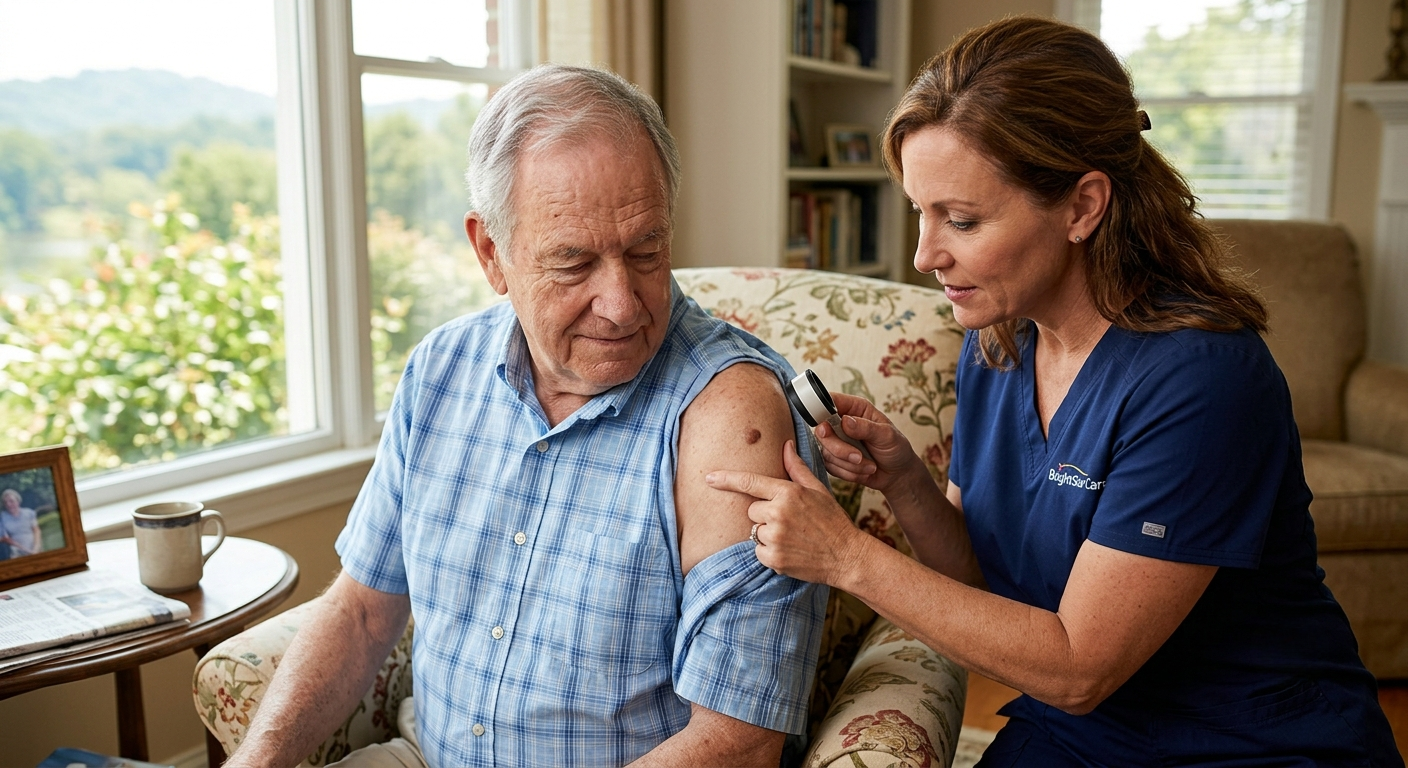
Skin checks happen naturally during bathing or dressing assistance, which is exactly when a trained caregiver is most likely to notice a new or changing spot on a parent's back, scalp, or shoulders. These are areas people rarely examine themselves in a mirror. RN-supervised care adds follow-through that families managing care alone often struggle to maintain. A noted change gets documented and a dermatology referral gets arranged, rather than mentioned once and forgotten in a busy week.
What Red Flags Do Families Often Overlook?
A mole that's changed size or color, a sore that hasn't healed in three weeks, and bleeding or crusting with no clear cause are the signs families most often miss.
- A mole that has changed size, shape, or color over the past few months.
- A sore or scaly patch that has not healed within three weeks.
- A new dark spot on the scalp, back, or backs of the legs, areas rarely self-checked.
- Bleeding or crusting from a spot with no clear injury to explain it.
Any one of these warrants a dermatologist visit, particularly in a parent with a lifetime of outdoor sun exposure.
How Can Seniors Still Active Outdoors in East Tennessee Stay Sun Safe?
A wide-brimmed hat, broad-spectrum sunscreen with at least SPF 30 reapplied every two hours, and avoiding peak sun between 10 a.m. and 4 p.m. are the simplest, most effective habits. Gardening in Maryville, walking Knoxville's greenways, or an afternoon at Tellico Village all add up to real UV exposure, even on cloudy days. None of this means staying inside all summer; it means being intentional about when and how that outdoor time happens.
How RN-Supervised Home Care Supports Knoxville Seniors
At BrightStar Care of Knox, Anderson, Blount Counties, every caregiver works under the supervision of a Registered Nurse, including our Director of Nursing, an RN who oversees care for clients across Knoxville, Oak Ridge, Maryville, Farragut, and the surrounding counties we serve. That oversight means a changing mole or a sore that won't heal gets noticed, documented, and followed up on. We are Joint Commission Accredited and locally owned and operated, and we accept long-term care insurance, Medicaid, workers comp, and private pay.
To schedule a free in-home consultation, call (865) 690-6282.
Local Resources
Skin Cancer Foundation, (212) 725-5176, skincancer.org American Cancer Society, (800) 227-2345, cancer.org University of Tennessee Medical Center, (865) 305-9000, utmedical.org Tennessee Department of Health, East Regional Office, (865) 546-9221, tn.gov/health East Tennessee Area Agency on Aging and Disability, (865) 691-2551, ethra.org
Frequently Asked Questions
What does early skin cancer look like on an older adult?
It often looks ordinary: a new mole, a pearly bump, or a scaly patch that doesn't heal within a few weeks. Basal cell and squamous cell skin cancers, the most common types in older adults, rarely look alarming early on, which is why regular skin checks matter more than waiting for something to look obviously wrong.
What is the ABCDE rule for checking moles?
It stands for Asymmetry, Border irregularity, Color variation, Diameter larger than a pencil eraser, and Evolving size or shape. A spot doesn't need to match every letter to be worth a dermatologist visit.
How often should an older adult get a professional skin check in the Knoxville area?
The American Academy of Dermatology generally recommends an annual skin exam for adults, with more frequent checks for anyone with a personal or family history of skin cancer. Caregivers who assist with bathing are often first to notice a new or changing spot between appointments.
How can home care help an aging parent stay safe in the sun this summer?
An RN-supervised caregiver can help with sunscreen reminders, appropriate clothing, and timing outdoor activities away from peak UV hours, while watching for new or changing spots. To learn more about in-home support in Knoxville, Oak Ridge, or Maryville, call BrightStar Care of Knox, Anderson, Blount Counties at (865) 690-6282.
Sources
Skin Cancer Foundation, Skin Cancer Facts and Statistics, skincancer.org Centers for Disease Control and Prevention, Sun Safety and UV Exposure, cdc.gov American Academy of Dermatology, UV Safety Awareness Month, aad.org American Academy of Ophthalmology, UV Safety and Eye Health, aao.org National Cancer Institute, Skin Cancer Prevention, cancer.gov