
.png "1-(1).png")
It’s not as simple a decision as you may think
You found someone who will do it for less. A friend of a friend, an aide who worked for a neighbor, maybe someone your mother already knows and likes. Her rate beats the agency quote and she can start Monday.
Here is the part that families usually do not hear or realize until later. Hiring a caregiver privately in New Jersey is not just a lower hourly rate. It makes you the employer, and since July 1, 2024, the state has been specific about what that job involves. The real difference between the two options is not the hourly price, but the total cost. It is who carries the paperwork, the insurance, and the risk.
What is the actual difference between hiring privately and going through an agency?
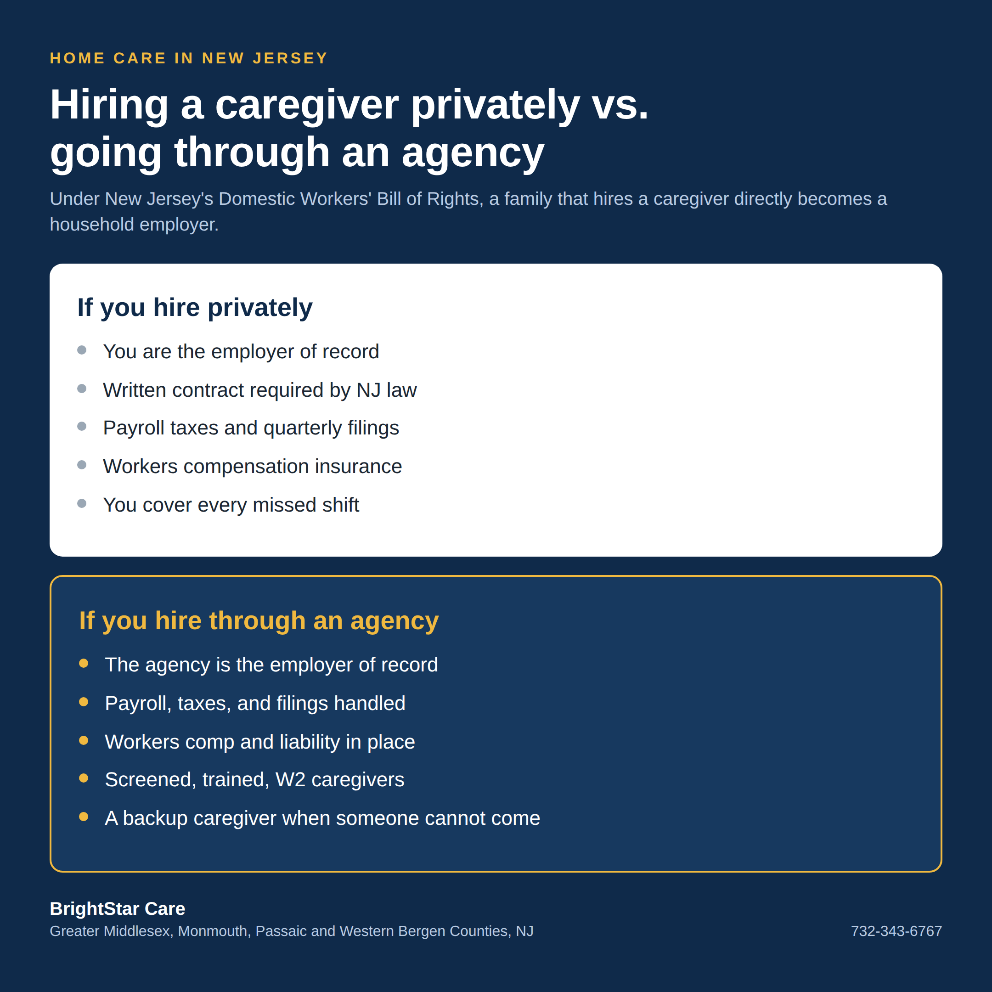
When you hire privately, you employ the caregiver directly. You set the schedule, you pay her, and every obligation that comes with employing someone belongs to your family.
When you hire through an agency, the agency is the employer. It handles screening, training, payroll, taxes, insurance, supervision, and coverage when your caregiver cannot come. You are buying in-home care as a service rather than taking on a household staff member. The hourly pay gap between the two may be real, but it does not show you is the work, additional costs and the liability that moves to you personally.
If we hire someone ourselves, are we really the employer?
In almost every case, yes. The IRS lists health aides and caretakers as examples of household employees, and the test is control. If you decide what gets done, how it gets done, and when the person comes and goes, that is an employee.
Paying in cash does not change that, and neither does handing someone a 1099 in January. When the classification is wrong, the family is who the IRS and the state come back to.
What does New Jersey require of us as a household employer?
New Jersey's Domestic Workers' Bill of Rights took effect July 1, 2024, and it applies to private households, not just to companies. If your caregiver works more than five hours a month on a regular basis, the state expects the following.
- A written contract, in English and in the worker's preferred language, covering duties, wages, overtime, schedule, breaks, sleeping periods, and leave. The state publishes a model contract.
- State minimum wage for all hours worked, $15.92 an hour for most employees in 2026, plus overtime at time and a half past 40 hours.
- A paid 10-minute rest break every four hours and a 30-minute meal break after five straight hours.
- For a live-in caregiver, a 24-hour rest period after six consecutive days.
- Up to 40 hours of earned sick leave a year.
- Two weeks’ notice before you end the arrangement, four weeks if the caregiver lives in.
- Records of hours, pay rate, breaks, and leave.
The contract also cannot include noncompete, arbitration, or non-disparagement clauses. Domestic workers are covered by New Jersey's Law Against Discrimination, and if you act against a worker within 90 days of her raising a complaint, the law presumes retaliation and the employer must show otherwise.
What taxes are we responsible for?
Once you pay a household employee $3,000 or more in cash wages during 2026 (for example), Social Security and Medicare apply, and the employer share is 7.65 percent on top of the wage. Pay $1,000 or more in any calendar quarter and federal unemployment tax applies too.
New Jersey uses that same $1,000 mark. Cross it and you are expected to get a federal EIN, register with the state, and withhold and remit for unemployment, temporary disability, family leave, and state income tax, with quarterly filings. A household payroll service can run all of it, and plenty of families use one. The responsibility still sits with you.
What happens if the caregiver gets hurt in my parent's house?
This is the one most family member’s rarely see coming. New Jersey requires household employers to carry workers compensation coverage for domestic workers. Most homeowners’ policies do not include it, and many families assume theirs does. Call your carrier and ask before anyone starts. Nobody likes surprises.
Caregiving is physical work. Transfers, stairs, a wet bathroom floor, a parent who loses her balance and gets caught on the way down. If a caregiver is hurt working for an uninsured household employer, the medical bills and lost wages can land on the family personally, on top of state penalties.
Who covers the shift when the caregiver is sick, quits, or does not show up?
You do. This is the difference families feel first, usually more often than they anticipate.
A private caregiver has no bench behind her. When she has the flu, a funeral, a vacation, or a sick child of her own, someone in the family takes the day. When she gives notice, you restart the search while your parents’ needs stay the same. An agency's job is to have the next qualified person ready (which is one reason we employ over 300 caregivers), and to know the case well enough that the next person is not starting from zero.
Who is watching the care itself?
A privately hired caregiver reports to your family. That works until something changes. If your father's ankles are more swollen than last week, if he is sleeping through the afternoon, if the pills in the organizer are not moving, someone must notice and know what it means.
At BrightStar Care, a Registered Nurse builds the plan of care and oversees every case, and skilled nursing care is available when the situation calls for it. No agency can promise an outcome. What supervision does is shorten the time between a change and someone acting on it.
Is hiring privately ever the right call?
Sometimes. A few hours a week of companionship, a ride to church, and errands, with a family that has the time to run payroll, keep records, carry a workers compensation policy, and cover the gaps.
It stops working when the need grows. Overnight help, mobility assistance, proper bathing/showering, fall avoidance, dementia that makes the days unpredictable, medications that must be right, a parent who should not be alone. At that point you are not hiring a helper, you are staffing a schedule that must be adhered to. That may take 2-3 caregivers, a backup for each of them, and someone supervising all of it.
What does the price difference actually buy?
Side by side, the agency rate covers work that otherwise becomes yours.
- The agency is the employer of record, not your family.
- Payroll, taxes, and quarterly filings are handled.
- Workers’ compensation and liability coverage are in place, and caregivers are bonded and insured.
- Caregivers are background screened, trained, and W2 employees.
- A Registered Nurse writes the plan of care and oversees the case.
- Someone covers the shift when your caregiver cannot make it.
- The New Jersey contract, break, notice, and recordkeeping rules belong to the agency.
- You have one number to call when something changes.
Questions families ask us about this
Can I just pay a caregiver in cash?
You can pay however you like, but the obligations do not disappear because the money is cash. Once you cross the federal and state wage thresholds, the withholding, filings, and coverage requirements apply. Unpaid amounts tend to surface later through an unemployment claim, a disability claim, or an injury.
Is a private caregiver an independent contractor if she sends me an invoice?
Usually not. Classification depends on control, not paperwork. If you set the hours, the tasks, and how the work is done, the IRS and the state will generally treat that person as your employee no matter what the invoice says.
Do I need workers compensation insurance for a caregiver in New Jersey?
New Jersey requires household employers of domestic workers to carry it. Homeowners’ policies commonly exclude injuries to household employees, so confirm with your carrier rather than assuming you are covered.
We already have a caregiver we like. Can an agency take her on?
It is worth asking. Some caregivers are willing to apply to the agency, and if they meet the hiring, screening, and training standards, a family can sometimes keep the person their parent is comfortable with while the agency takes on the employment side.
Talking it through before you decide
Most families are not choosing between good and bad here. They are choosing between a lower rate (but likely a higher cost all in) with everything attached to it and a higher rate with the employment side handled. That question gets easier to answer once you know what your parent needs each week and the related financial burden of being the employer.
BrightStar Care of Greater Middlesex, Monmouth, Passaic and Western Bergen Counties is a family owned, Joint Commission accredited home care agency serving those New Jersey counties, with RN-led care available 24 hours a day, 7 days a week. If you want help sorting out how many hours the situation calls for, we offer a free in-home care assessment. Call 732-343-6767 and we will walk through it with you.
This article is general information, not legal or tax advice. Wage rates, thresholds, and state rules change. Confirm the current requirements with your own accountant or attorney before you hire anyone.