
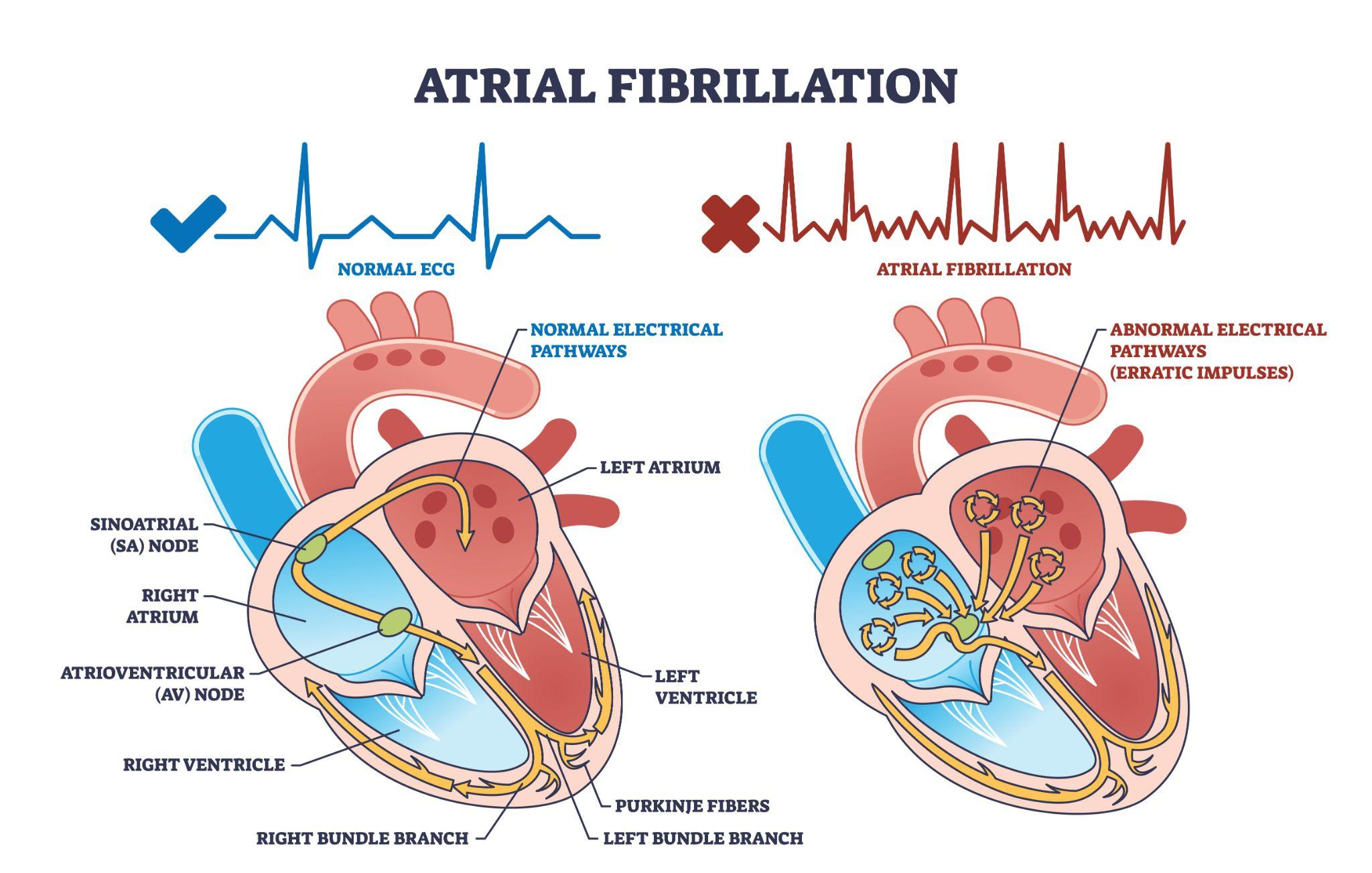
Atrial fibrillation, usually shortened to AFib, is the most common sustained heart rhythm disorder in older adults, and it carries one of the highest preventable stroke risks in medicine. For families in Phoenix, Arcadia, and Tempe caring for a parent with AFib, the stakes are real: AFib increases stroke risk roughly fivefold, and prevalence climbs from less than 1% in middle age to about 9% in adults age 80 and older.
The good news is that AFib is largely manageable at home, with the right medications, careful monitoring, fall-risk management, and skilled nursing oversight. The harder news is that the medications used to prevent AFib-related stroke (anticoagulants, often called blood thinners) carry their own bleeding risks, particularly for older adults who fall. Navigating that balance is one of the most important and most overlooked parts of senior care.
This guide explains what AFib is, how it leads to stroke, what home care looks like for older adults living with the condition in Phoenix, why Arizona’s heat matters more than many families realize, and the local resources available.
What Atrial Fibrillation Is, in Plain Language
In a healthy heart, the upper chambers (the atria) and lower chambers (the ventricles) beat in a coordinated rhythm. In AFib, the atria quiver instead of beating, an irregular, often rapid pattern that allows blood to pool. Pooled blood can form clots, and if a clot travels to the brain, it causes an ischemic stroke. That is the central danger of AFib.
AFib can be paroxysmal (it comes and goes on its own), persistent (it stays until treated), or permanent. Symptoms include palpitations, fatigue, shortness of breath, lightheadedness, or chest discomfort. Many older adults, however, have “silent” AFib with no symptoms at all, often discovered during a routine exam, when a smartwatch flags an irregular pulse, or, in the worst case, after a stroke.
Why Stroke Prevention Is the Top Priority
AFib raises stroke risk roughly fivefold across the population. In adults age 65 to 75 with AFib, the annual stroke rate without anticoagulation is about 3 to 5%, and it rises further with each additional decade of age. Physicians use the CHA₂DS₂-VASc score to estimate stroke risk and decide whether to prescribe anticoagulation. Options today include warfarin and the newer direct oral anticoagulants (DOACs) such as apixaban, rivaroxaban, dabigatran, and edoxaban.
Current guidelines from the American Heart Association and American College of Cardiology recommend anticoagulation for nearly all patients age 65 and older with AFib. In practice, though, up to half of older adults don’t receive it, often because clinicians, patients, or families fear falls and bleeding. Multiple studies show that the stroke risk from untreated AFib outweighs the bleeding risk from anticoagulation in most older patients, even those with a history of falls. The right response to fall risk is rarely to stop the blood thinner; it’s to reduce the chance of falling.
Medication Management at Home
A skilled home nurse plays a critical role in keeping an AFib patient stable and out of the hospital. That role typically includes:
- Verifying the patient takes the right dose at the right time each day
- Coordinating with the prescriber on dose adjustments based on weight, kidney function, and other medications
- Watching for dangerous drug interactions, NSAIDs, certain antibiotics, antifungals, and many over-the-counter supplements interact with anticoagulants
- For patients on warfarin: monitoring INR results and communicating with the anticoagulation clinic
- Recognizing bleeding warning signs, unusual bruising, nosebleeds, blood in urine or stool, prolonged bleeding from minor cuts, or severe headache
- Heart rate and rhythm monitoring; some patients use home ECG devices that connect directly to their cardiologist’s portal
- Medication reconciliation after every hospital or ER visit, when prescriptions change, errors are most likely
This is exactly the kind of clinical work that often determines whether someone with AFib stays steady at home or cycles in and out of the emergency department.
Fall Risk Management Without Sacrificing Stroke Protection
The fear of bleeding from a fall is the most common reason anticoagulation is withheld in older adults. But the data are clear: for most seniors with AFib, the stroke risk from stopping anticoagulation is much greater than the bleeding risk from continuing it. The right answer is rarely “stop the blood thinner.” It’s “reduce the fall risk.” A Registered Nurse working in the home can:
- Conduct a fall-risk assessment on the first visit and reassess regularly
- Identify trip hazards, lighting issues, and bathroom safety gaps
- Review the medication list for fall-contributing drugs (sedatives, certain blood pressure medications)
- Recommend grab bars, raised toilet seats, non-slip flooring, and appropriate footwear
- Coordinate with physical therapy if balance training is appropriate
- Train family caregivers in safe transfer and ambulation techniques
How RN-Supervised Home Care Helps AFib Patients in Phoenix
At BrightStar Care of Phoenix NW/NE and Tempe, a Registered Nurse performs the first home assessment, builds a personalized care plan, and supervises every visit. For AFib patients, medication management is a primary focus, a clear daily schedule, real-time review of doses taken and missed, watchfulness for interactions and bleeding, and direct communication with the prescriber when something changes.
Because there is no minimum hour requirement, families can start with weekly RN check-ins and personal care support, then scale up as needs change. Every direct-care caregiver holds a Level 1 Arizona fingerprint clearance card. The agency is state licensed, has been Joint Commission Accredited, and is locally owned and operated. BrightStar provides private duty nursing and personal care, the model is built for ongoing chronic-condition support rather than short post-acute episodes.
Phoenix-Specific Context: Heat, Hydration, and AFib
Phoenix summers create real risk for older adults with AFib, and families in Arcadia, Tempe, and across Phoenix should plan for it well before July temperatures arrive. Dehydration is a well-known AFib trigger, it lowers blood volume, increases heart rate, and can push the heart into rhythm changes. Several common medications, diuretics for heart failure or blood pressure, for example, amplify fluid loss and become harder to dose predictably in hot weather.
Older adults in Phoenix often underestimate how much fluid they’re losing because the dry desert air evaporates sweat before they feel it. Families and caregivers should:
- Encourage regular fluid intake (unless restricted by the physician for heart failure)
- Time any outdoor activities for early morning
- Watch for signs of dehydration, dizziness, dry mouth, dark urine, or confusion
- Maintain air conditioning systems before summer and have a backup cooling plan during power outages
- Recognize that increased heart rate or new palpitations in summer may signal an AFib episode triggered by dehydration
Maricopa County has one of the largest older-adult populations in the Southwest, and heat-related emergency department visits among seniors with cardiac conditions spike every summer. An RN supervising care at home can catch dehydration and rhythm changes before they become emergencies.
Local Resources for Phoenix-Area Families
- American Heart Association, Arizona Affiliate: heart.org/affiliates/arizona
- Banner – University Medical Center Phoenix, Cardiology: 602-839-2000, bannerhealth.com
- Mayo Clinic Arizona (Phoenix), Heart Rhythm Services: 480-301-8000, mayoclinic.org
- Area Agency on Aging, Region One, 24-Hour Senior HELP LINE: 602-264-4357 / 888-264-2258, aaaphx.org
- Maricopa County Department of Public Health: 602-506-6900, maricopa.gov/Health
Frequently Asked Questions
Is AFib dangerous on its own, or is stroke the only concern?
Stroke is the headline risk, but uncontrolled AFib also contributes to heart failure, cognitive decline, and reduced quality of life over time. Long-term rate or rhythm control improves how a person feels day to day, even before considering stroke prevention.
My mom is on a blood thinner and just fell. Should we stop the medication?
Don’t stop or change any blood thinner without talking to her physician first. A single fall almost never justifies stopping anticoagulation, the stroke risk is typically higher than the bleeding risk. Watch for signs of internal bleeding (severe headache, confusion, weakness, blood in urine or stool) and seek emergency care if any of those appear. Then call her physician to review the fall and discuss any needed adjustments.
Can a home care nurse adjust my parent’s AFib medications?
A home care RN doesn’t prescribe or independently adjust medications, but she coordinates with the prescriber, monitors for side effects and interactions, reports concerns promptly, and helps the patient follow the plan exactly. That kind of clinical supervision is often what separates a stable patient from one who ends up in the ER. To learn more about RN-supervised home care for AFib in Phoenix, Arcadia, or Tempe, call BrightStar Care of Phoenix NW/NE and Tempe at 480-897-1166.
Does AFib feel different in summer?
Many patients report more frequent or more intense episodes during Phoenix summers, often connected to dehydration, electrolyte changes from sweating, or medication timing. If episodes increase, talk to the cardiologist about whether hydration, medication timing, or activity adjustments are needed before the next heat wave.
How often should an older adult with AFib see their cardiologist?
Typically every three to six months, more frequently if rate or rhythm are unstable, or after any medication change. Between visits, an RN-supervised home care plan provides ongoing monitoring and connects the dots back to the cardiologist when something changes.
Talk to a Phoenix-Area RN About AFib Home Care
If you’re caring for a parent or spouse with atrial fibrillation in Phoenix, Arcadia, or Tempe, BrightStar Care of Phoenix NW/NE and Tempe can help. Call 480-897-1166 to schedule a free in-home assessment with a Registered Nurse. There’s no minimum hour requirement, every caregiver holds a Level 1 fingerprint clearance card, and the agency has been Joint Commission Accredited.
Sources
- American Heart Association, Atrial Fibrillation overview and patient resources (heart.org)
- 2023 ACC/AHA/ACCP/HRS Guideline for the Diagnosis and Management of Atrial Fibrillation (jacc.org)
- Cleveland Clinic Journal of Medicine, Fall risk and anticoagulation for atrial fibrillation in the elderly (ccjm.org)
- JACC, Management of Atrial Fibrillation in Patients 75 Years and Older: State-of-the-Art Review
- Journal of the American Heart Association, Trends in stroke-related mortality in atrial fibrillation patients (CDC WONDER analysis)
- Area Agency on Aging, Region One, aaaphx.org