
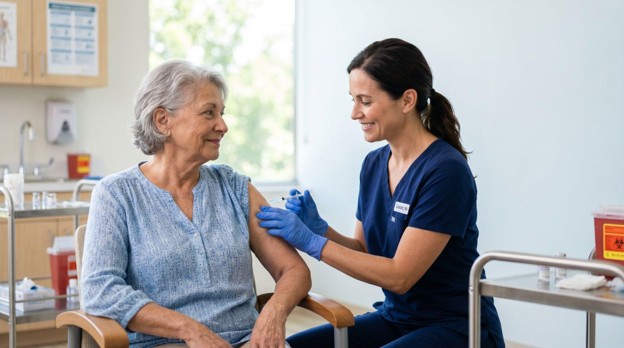
A vaccine given for one reason may be doing something bigger. A Stanford-led study published in Cell in December 2025 found that among people already living with dementia, becoming eligible for the shingles vaccine was linked to slower disease progression, fewer new mild cognitive impairment diagnoses, and a meaningful drop in mortality within nine years. It builds on earlier 2025 research suggesting the vaccine may also lower the odds of developing dementia in the first place.
We've been helping Bergen County families for more than 15 years, and August's National Immunization Awareness Month is when we hear the same question over and over: "Is Mom even up to date?" Whether you're in Rutherford or managing things from Paramus, keeping a parent's vaccinations current gets harder once appointments and Route 4 traffic get added to an already full week. Families in Hackensack, Emerson, Westwood, and Lyndhurst ask us this constantly, and lately the shingles vaccine has become a bigger part of that conversation.
This article covers the new research on the shingles vaccine and Alzheimer's progression, which other vaccines matter most for older adults, and how home care can keep a parent's shots on schedule.
Quick answer: Recent research suggests the shingles vaccine may help alter the course of Alzheimer's, including slower progression and lower mortality in people already diagnosed, and may also lower the odds of developing dementia in the first place, though it isn't a treatment. Adults 65 and older should also stay current on the annual flu shot, a pneumococcal vaccine, and a Tdap booster every ten years. A primary care provider can confirm what's due.
Can the Shingles Vaccine Help Alter the Progression of Alzheimer's?
Growing research suggests it might, particularly for people already diagnosed, though it's a vaccine benefit, not a dementia treatment. The finding traces to a natural experiment in Wales, where a vaccination program's eligibility cutoff, based on exact birth date, let Stanford researchers compare otherwise similar older adults who did and didn't qualify for the shingles vaccine. The December 2025 study, published in Cell, found that among people already living with dementia when they became eligible, vaccination was linked to fewer new mild cognitive impairment diagnoses and a meaningful drop in mortality over nine years, suggesting it may help slow how the disease progresses. It builds on earlier 2025 research finding eligible adults were also less likely to develop dementia in the first place. Researchers believe reducing viral reactivation in the nervous system may lower inflammation linked to Alzheimer's. It's promising, not proven, and doesn't change the recommendation to get vaccinated at 50 or older.
What Other Vaccines Should an Aging Parent Get During Immunization Awareness Month?
Most adults 65 and older need an annual flu shot, a pneumococcal vaccine, and an up-to-date Tdap schedule, alongside the shingles vaccine. The flu vaccine matters every year because the virus changes and immunity fades; CDC's most recent complete season data show coverage among adults 65+ fell to 63.8%, short of the national goal. Pneumococcal vaccination guards against a pneumonia that hospitalizes older adults more severely than younger ones. A Tdap booster, needed roughly once a decade, protects against tetanus, diphtheria, and whooping cough. A primary care doctor, pharmacist, or home care nurse can review what's current in one conversation.
What Does a Missed Vaccination Actually Look Like in Real Life?
It rarely looks dramatic. It usually looks like a bad case of "the flu" that turns into a hospital stay. A parent who seemed fine Monday can be in the emergency room by Thursday, especially with diabetes, COPD, or heart disease in the mix. We've talked with daughters from Wood-Ridge who describe the same pattern: a lingering cold, a cough that turned into pneumonia, a hospital stay a vaccine could have shortened. Between work, kids, and everything else, a shingles booster due in March quietly becomes "sometime this year."
How Does an In-Home Caregiver Help Keep Vaccinations on Track?
A trained caregiver tracks what's due, schedules the appointment, and gets a parent there, then follows up on how they're feeling. Our RN-supervised caregivers review a client's vaccination history during intake and coordinate with the family's physician. For a parent anxious about needles, a familiar caregiver's presence helps. If you're calling from Carlstadt or East Rutherford after work, a caregiver on the ground can confirm the shot happened.
What Red Flags Do Families Miss When It Comes to Senior Vaccinations?
- Assuming a past vaccine still counts. Shingles and pneumococcal vaccines aren't annual, and schedules have changed.
- Treating mild soreness after a shot as a reason to skip future vaccines, when it's a normal, short-lived response.
- Not asking about interactions with other medications, especially blood thinners.
- Assuming the pharmacy and primary care office track the same list. Often they don't.
How BrightStar Care of Greater Hackensack Can Help
We meet you wherever you are, whether that's a parent in Hasbrouck Heights who just needs a ride and a reminder, or a situation in Westwood where medication and vaccine tracking both need an RN's eye. BrightStar Care of Greater Hackensack is Joint Commission Accredited, nurse-led with RN supervision on every case, and locally owned and operated. We've served Bergen County families for more than 15 years, and immunization tracking is part of the care plans we build.
If you're not sure what your parent is due for, call 201-483-8490 for a free in-home consultation.
Local Resources
CDC-INFO Adult Vaccine Information, 1-800-232-4636, cdc.gov/vaccines-adults Vaccines.gov Vaccine Finder, vaccines.gov Bergen County Division of Senior Services, (201) 336-7400 NJ 211 Community Resources, 211, nj211.org Hackensack Meridian Health, hackensackmeridianhealth.org
Frequently Asked Questions
Does the shingles vaccine really help with Alzheimer's? Recent research, including a December 2025 Stanford-led study in Cell, suggests becoming eligible for the shingles vaccine may help alter Alzheimer's progression in people already diagnosed, and earlier research links vaccination to lower dementia risk overall. It's encouraging, not a proven treatment, and doesn't change the recommendation to get vaccinated at 50 or older.
What vaccines are recommended for seniors over 65? An annual flu shot, a pneumococcal vaccine, the two dose shingles vaccine, and a Tdap or Td booster every ten years, adjusted for health history.
How often do seniors need a shingles vaccine? The recommended shingles vaccine (RZV) is given as two doses, typically two to six months apart, as a one-time series rather than an annual shot.
Can a home caregiver take my parent to get vaccinated? Yes. RN-supervised caregivers with BrightStar Care of Greater Hackensack can coordinate appointments, provide transportation, and check in on how a parent feels afterward.
What if my parent in Bergen County has missed several vaccines? It's common, and fixable. Call BrightStar Care of Greater Hackensack at 201-483-8490 for a free in-home consultation, and we'll help figure out what's due.
Sources
Cell, The Effect of Shingles Vaccination at Different Stages of the Dementia Disease Course, cell.com Stanford Medicine, Shingles Vaccination Linked to Lower Dementia Risk, med.stanford.edu CDC FluVaxView, Flu Vaccination Coverage United States 2024 to 25 Influenza Season, cdc.gov CDC AdultVaxView, Vaccination Coverage Among Adults National Health Interview Survey 2024, cdc.gov National Institute on Aging, Vaccines and Older Adults, nia.nih.gov