
Discharge day feels like the finish line. The paperwork is signed, the bag is packed and everyone is relieved to be heading home. But for most families, the hardest part of recovery begins the moment the front door closes. There are medications to sort, instructions to interpret, follow-up appointments to schedule and a loved one who is far less steady than anyone expected.
Maybe you are the adult daughter who took a week off work and is realizing a week will not be enough. Maybe you are the spouse in your eighties trying to help someone your own size out of a chair. Maybe you live in another state, calling twice a day and hearing "everything's fine" in a voice that tells you otherwise. At BrightStar Care of Greater Scottsdale, we step into exactly that gap. The hospital treated the immediate problem. Now someone has to manage the recovery, and nurse-led transitional care means you get to be family again, rather than full-time nurse, scheduler and pharmacist.
The First Weeks Home Ask More of Families Than Anyone Expects
Hospital stays are shorter than they once were. Whether your loved one is coming home from an HonorHealth campus in Scottsdale, Mayo Clinic, or a rehabilitation facility elsewhere in the Valley, they are likely arriving earlier in their recovery than families expect: still healing, still adjusting to new medications and still weeks away from moving the way they did before.
In those first weeks, families often find themselves managing all of this at once:
- New medications on unfamiliar schedules, sometimes replacing ones your loved one took for years.
- Wounds or incisions that need to stay clean, dry and watched.
- Mobility limits and weight-bearing restrictions that change how every room in the house works.
- Follow-up appointments, referrals and phone calls that all seem to require a different portal.
- Overnight hours when nobody is awake to notice if something goes wrong.
What families tell us is rarely about one dramatic moment. It is the accumulation: wondering whether a symptom is normal, second-guessing a dose, lying awake listening for movement down the hall. That constant low-grade vigilance is exhausting, and it is not a sign you are failing. It is a sign the situation calls for clinical support rather than willpower.
A Discharge Folder Is Not a Care Plan
Families leave the hospital with a stack of instructions written in clinical language, often handed over during a rushed conversation while everyone is focused on getting to the car. Take this twice daily. Watch for signs of infection. Restrict weight-bearing for six weeks.
Those directions matter enormously, and they are also easy to misread when you are depleted and unfamiliar with the terminology. Our Registered Nurses turn that paperwork into a daily rhythm you can actually follow, spelling out what happens each morning and evening, which medications go together, what your loved one's physician wants you watching for and the answer to the question families ask most: who do I call first, and when. That clarity lifts a real weight off the family member who has been quietly worried about getting something wrong.
When Recovery Involves More Than Rest
Some homecomings are straightforward. Many are not. A loved one may come home with clinical needs that go well beyond rest and reminders:
- A surgical wound requiring skilled dressing changes.
- IV antibiotics or infusion therapy to complete at home.
- A catheter or ostomy to manage.
- Oxygen or ventilator support.
A new diagnosis layered on top of conditions they were already managing.
This is where nurse-led care matters most. BrightStar Care of Greater Scottsdale delivers skilled nursing in the home, so clinical complexity does not automatically mean a move to a facility. Every plan is overseen by a Registered Nurse who assesses your loved one directly, adjusts care as their condition changes and stays reachable when questions come up. That oversight is standard on every case we take, not an upgrade.
If your loved one is coming home in the next few days and you are not sure the plan is realistic, call us at (480) 302-5139. We can talk it through before discharge, not after.
Support That Steps Back as Strength Returns
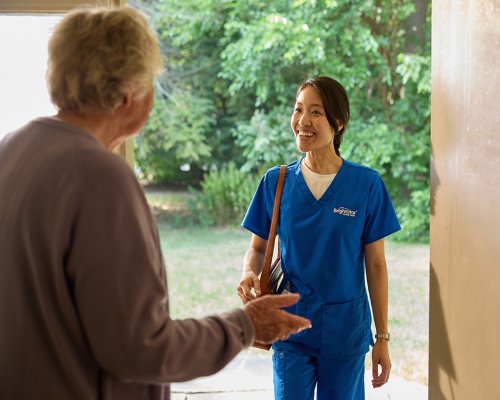
The goal of transitional care is never permanence. It is independence, in the place your loved one already knows by heart. Their own bed, their own kitchen, their own routines, and the quiet that lets real rest happen.
In the first days home, that may mean hands-on help with bathing, dressing, moving safely between rooms and staying on top of medications. A few weeks later, it may only mean check-ins and a hand with errands. Our team scales support to match progress, watching for the signals that your loved one is ready for more autonomy and handing responsibilities back as soon as it is safe. Recovery is not linear, and a plan that cannot flex stops fitting by week two.
Quick FAQs About In-Home Transitional Care
How long do most families need transitional care?
It depends entirely on the procedure and the person. Some families use support for a few weeks after a hospital or rehab stay, then taper off. Others continue longer when a chronic condition needs ongoing management. We reassess as recovery progresses rather than locking you into a fixed term.
How does this work alongside home health visits my loved one's doctor ordered?
The two often work together. Physician-ordered home health typically involves brief, intermittent visits focused on specific clinical goals. Our care can provide sustained daily presence, hands-on personal care and extended hours around those visits. We are happy to talk through how the pieces fit for your loved one's situation.
Can you support recovery after a stroke, cardiac event or joint replacement?
Yes. These recoveries involve mobility limitations, therapy protocols and medication changes that benefit from consistent, trained support at home, and our nurses work directly from your loved one's prescribed plan of care.
You Made It Home. Let's Make Sure You Stay There.
A hospital stay ends, but recovery keeps going, and those following weeks deserve as much attention as the treatment itself. With the right support at home, your loved one heals where they are most comfortable, and you get to be a daughter, a son or a spouse again instead of a full-time nurse, scheduler.
BrightStar Care of Greater Scottsdale serves families in Scottsdale, Paradise Valley, Fountain Hills, Carefree, Cave Creek and the surrounding communities, with care available hourly, overnight or around the clock.
Call BrightStar Care of Greater Scottsdale at (480) 302-5139 to talk with a care specialist about nurse-led transitional care for your family.